Category Archives: Service Projects

7 Ways to Help When You Have Nothing to Give

Publication1

Life is expensive. Kids outgrow their shoes overnight, cars break down, and there is ALWAYS some home improvement project that needs attention. Finding additional money to donate for worthy causes like hunger is a challenge. Most of us don’t have the Bill Gates/Warren Buffet type of disposable income to make huge gifts. In fact, most of us use everything we have just to take care of our own. It can be discouraging, I know, but don’t despair! There are lots of things you are already doing that can be used to make a difference. And when my little bit joins up with yours, before you know it we’re contributing millions.

Here is a list of 7 ways that you can help when you have nothing to give.

Time is Money: It seems like you go through seasons in life when there is just not enough time, and seasons when there is not enough money. I’m in a “not enough time” season right now; our bills are paid, but I’m working six days a week while going to grad school on the side. Back when I was a stay-at-home mom, I had more time on my hands, but the finances were tighter. (And yes, sometimes you feel like you have neither time nor money. It happens. If you’re there right now, I hope it ends soon for you and you can reclaim some of your financial and/or scheduling independence.) If you’re retired, a stay at home parent, seasonally employed, or temporarily out of work, you may not have disposable income, but your free time isn’t free, it’s valuable!

  1. Volunteer: Nearly all non-profit organizations use volunteer labor, and there are jobs for volunteers of all ages and abilities. You can pack meals at Feed my Starving Children or Kids Against Hunger. Volunteer at a food bank or soup kitchen. If you don’t know where to start, hit the internet and run a quick search for non-profit orgs near you, ask friends where they volunteer, or ask your pastor for suggestions.
  2. Use your Time to Cut your Costs: When my schedule was a bit looser, I used to spend more time planning out my grocery spending. I got really good at matching coupons with store sales, shopping on the special double coupon days, and I trimmed my family’s grocery budget (which included: food, cleaning supplies, personal hygiene items, and pet food) by $150/month. It took time, for sure, but that time paid me well! Click HERE for Pocket Your Dollars, the blog that helped me find the matchups.
  3. Use your Time to Make Some Money: I know this is really basic, but I’m not necessarily talking about taking on another job, just using a day or a weekend for your favorite cause. Holding a garage sale is a great way to make some money while cutting clutter. You can also sell your unwanted items on eBay, or drop off some clothes, shoes, and accessories at a consignment shop. Clean out the kids’ closets and the sporting goods in the shed and make a run to Once Upon a Child or Play it Again Sports.

Shopping and Gift Giving: Gift giving is a big expense. We all love to spoil our friends and family members, but that really adds up! There are a few things you can do to use those gifts to help more than one person

  1. Credit Card Programs: Many credit cards these days have rewards programs. For example, when I use my card, I get points that I can redeem for gift cards to a wide variety of restaurants, retail stores, etc. Those gift cards make great gifts, or I can use them to shop for a gift. I know some people don’t use credit. That’s a totally valid choice that has a lot of benefits. But for those of us who responsibly do use cards, make sure you’re getting as much out of it as possible (and be careful; debt and identity theft are ugly monsters…).
  2. Org Gear: Some of your favorite charitable organizations have merchandise that you can purchase. The money benefits their programs, and the gear creates awareness when you wear it. For J’s birthday this year, one of his gifts was a tee from our favorite organization, Feed My Starving Children. The cost of the shirt provided 65 meals for kids in need. Some people are rotten hard to shop for. Making a charitable donation in their name is a great option. Find out what causes and charities your loved one is passionate about, and give to that cause in their name.
  3. Cause Apparel: There are a number of companies out there that use your purchases to employ the disadvantaged, teach job skills, or give a portion of their proceeds to charity. My sisters both got shirts from Sevenly for their birthdays. I spent the same amount as usual, but the gifts did double duty that both giver and recipient can feel good about. There are a lot of companies that fit this: Toms gives away a pair of shoes for every pair purchased (I still think they’re ugly, but to each his own). Noonday Collection and The Giving Keys sell accessories that give people work with dignity and help them dig their way out of poverty. There are a ton of good organizations like this – add the ones you’re familiar with in the comments!
  4.  Amazon Smile: I’ve mentioned this before on the Facebook page, but in case you missed it, you have to check out Amazon Smile. It’s really simple: instead of going to http://www.amazon.com, go to www.smile.amazon.com. Log in as usual, and chose a non-profit organization to receive a portion of the money you spend on Amazon. Most items are eligible (occasionally you see a third party seller’s item that isn’t eligible for the smile donation), the prices are the same as regular Amazon, and all the Prime members’ benefits count just like usual. You can change your charity, too. I like to switch mine up every couple months. Click HERE for the FAQ page about Amazon Smile.

There you go! Seven simple ways that you can help when you have nothing to give. I know there are more great ideas out there, share them in the comments!
What NOT to Donate to the Food Bank

What not to donate to the food bank

When my son was little, we passed the time on car rides by playing little games. One of his favorites was called, “You can’t eat that!” We would take turns naming things that you cannot eat, and then we would giggle about the silly notion of eating things like crayons, cars, and zombies with flamethrowers. Obviously I have only myself to blame for the sarcastic funny man my son has become. We’re like mediocre improv comics, or really bad Family Feud contestants (except we’re doing it on purpose. Seriously, click HERE for a YouTube video of some of the worst Family Food answers ever. Fair warning, it’s PG-13, so preview before you decide about showing it to the kids.)

In that spirit, we bring you first the funny and then the real
What Not to Donate to the Food Bank:

A piñata full of canned goods (ouch…)
Little refill packets for your E-Z-Bake Oven
Canned giraffe meat from your cousin the poacher
Plastic toy groceries from the kids’ play kitchen
Lotto tickets (unless it’s a big winner. No one would turn that down…)
Neked Grandma (if you watched the link above, you’ll get it)

Random items that no one in their right mind knows what to do with: You’re feeding the hungry, not cleaning out your fridge. Most food shelves have a set assortment that they give to each person who comes to them (cereal, canned fruit/veggies, dinner mix, etc.). Your random jar of pickled pig’s feet gets tossed in a bin of extras they can pick through, and most likely ends up in the dumpster when it expires, unclaimed. I understand that giving away what you can’t or won’t use is better than throwing it out, and someone out there may like pickled pig’s feet and be grateful for them. I’m not saying you should only stick to the stuff on the MOST WANTED LIST, but there is something condescending about using the food shelf as your trash can, giving only the junk you don’t want. Loving the hungry is about being thoughtful and intentional, not about brushing off your crumbs on the “little people.”

Expired food items: Yes, canned goods are “non-perishable.” No, they’re not really eternal. Many canned foods have an expiration date and past that date their safety and flavor may be compromised. Food banks cannot hand out expired food, and furthermore they have to pay someone (if they don’t have volunteers on the job) to sort through donations, checking expiration dates, shelving the useful, and disposing of the expired or damaged items. The human resource is an expensive one, don’t waste it.

*Also, understand the difference between a sell by or best by date and an expiration date. Manufacturers put the sell by/best by date on goods for the stores’ inventory process (and as a bonus to their sales numbers, it tricks many of us into throwing away perfectly good items and then repurchasing them.). The expiration date is a safety issue. Botulism is a potentially life-threatening, tasteless, odorless toxin that can grow in canned goods and isn’t killed by cooking the food. It’s not something to mess around with.

Home canned goods: Food shelves don’t accept home canned goods for the same reason they don’t take expired items – they just don’t know about the quality and safety. Home canned items don’t have an expiration date, they’re not labeled for nutrition and ingredients (read: possible allergens), and they’re easily contaminated by preparation in the same kitchen where you cook with flour, soy, nuts, and other common allergens that, even in tiny amounts, cling to jars from the same kitchen. If you garden and can like I do, use your bounty to cut your own grocery bill, freeing up money you can donate to the food shelf. If you have a bumper crop, share the wealth with family, friends, and neighbors. Offer them a jar of your spectacular preserves in exchange for a non-perishable item for the food shelf.

*Likewise, food shelves can’t take items without their labels. They need to know what’s in that can and when it expires. They also cannot accept cans that are significantly damaged. A dent, sure, but open packaging and cans with busted seams have to be tossed.

Over-the-counter (or prescription) medications: Food shelves are simply not equipped to deal with this sort of thing. Plus, some over-the-counter meds are ingredients in meth, so having them around is an added security issue for the food bank (that’s why some things are locked up at the pharmacy or stored behind the counter). There are other non-food items that many food shelves will accept such as diapers, baby wipes, feminine hygiene products, and personal hygiene items like soap and deodorant.

I am thankful for each and every person who gives from their comfort or their poverty to help another. From a dented can of corn to a million dollar check, every single gift is precious in God’s eyes and important in the fight against hunger. The point of this post is not to put a damper on anyone’s giving, but just to give you information on what to expect and why some gifts have to be turned down. It’s not that they’re ungrateful; the food banks’ policies and procedures are in place to protect them and their clients. When in doubt, ask. Food shelves are happy to answer your questions about donations.

Meal Ministry: How to BLESS not STRESS

Meal Ministry

Food doesn’t just meet our physical need for energy and nutrients; it’s also a source of comfort. That’s why there is something so powerful and community-building about meal ministry. When someone is ill, has a new baby, or experiences a loss, friends who show up to nurture and comfort the family with wholesome and delicious meals go a long way toward reducing stress. On the flip side, a friend who shows up unexpectedly with mystery foods the family can’t eat and who expects her dishes to be washed and returned right away actually increase stress! Keeping your friend’s needs in mind and having a humble attitude of service will steer you clear of most blunders. Here are a few simple things to avoid.

  1. Don’t Go At It Alone: Chances are if a friend is in a situation where meals would be a blessing, you’re not the only one who is bringing in food. Find out if a friend, family member, or someone at church is coordinating the meal ministry and get in contact with that person to sign up for a day when food is needed, get the info on any food preferences or allergies, get the address and directions, etc. That way your friend can relax and recover without the phone ringing off the hook, and she doesn’t have to worry about duplicate meals, giving directions, or getting conflicting information from different sources.
  2. Know Your Audience: When you get in touch with the person coordinating meals, or if you are the one doing the coordinating, find out what the family’s food preferences and food allergies are. If someone is vegetarian, gluten intolerant, or allergic to something, you need to provide a meal that won’t increase the suffering! Likewise, be sensitive to the issues created by the condition that drove the meal ministry. A new mom trying to nurse can’t eat a lot of garlic or gas-inducing veggies like broccoli. Someone dealing with stomach problems won’t be able to eat spicy or acidic things. If you know what your friend is dealing with, a quick internet search will give you advice on foods to avoid for her condition. Also, know what time your friend serves dinner. A family used to eating at 5:00 will not be very relaxed trying to placate fussy kids until dinner shows up at 8:00. You eat dinner whenever you like, but meal ministry is about blessing someone else, not about putting them on your schedule.
  3. No Surprises: I love sneaking extra veggies into my son’s food, and my own for that matter. Tiny cubes of squash soften beautifully in chili and no one knows the difference. It’s the only way I can get my husband or son to eat the stuff. But a meal ministry meal is not the place for sneaky veggies, mystery ingredients, and family secret recipes. Provide the recipe with each item you bring, and stick to what you put on the card. Your friend and her family will know exactly what they’re getting, and they can make it again another day. Obviously they’re going to love it and want the recipe anyway, right? I still make homemade chicken potpie from the recipe a friend brought for dinner when our son was born fourteen years ago.
  4. Keep It Simple: Elaborate dishes don’t travel well, and when you’re not feeling well, you just want the familiar and comfortable anyway. I had a friend thoughtfully bring me a casserole once that was a new recipe she was trying on us for the first time. Unfortunately she thought the word “clove” meant the entire head of garlic. I couldn’t eat garlic, so I couldn’t have any, and my house stunk for a week. Stick to things you know you make well. Someone coming home from hospitalization won’t care that it’s simple; she is just going to be thrilled to eat something that isn’t hospital food… Save your tricky, fancy dishes for when your friend is feeling better, then have her over for a celebration dinner! Likewise, while disposable bakeware isn’t the best for the environment, it is the best for ministry meals. Your friend can wash and reuse it herself or she can toss it. It’s a lot less work than scrubbing all the pans and keeping track of who to return them to. Remember that your goal is to help your friend relax and recover, not to give her more chores!
  5. If All Else Fails: Pizza delivery and restaurant gift cards are perfectly valid ways to bless a friend in need. This is especially true if you live too far away to deliver a homemade meal, when your schedule doesn’t match up to the meal delivery rotation, or in situations where a family member is hospitalized for a while. When my nephew was born prematurely and 300 miles away, I used Google Maps to find out what restaurants were near the hospital where he spent his first weeks. My sister and her husband were back and forth between home and the hospital, spending as much time as possible with their tiny baby, not eating at home. The gift cards we sent helped keep their costs down during that crazy and expensive time, and I felt good because it allowed me to bless them when I couldn’t be there in person.

Here is one of my favorite meal ministry recipes.  It’s vegetarian, mild, forgiving, easy, and generally pleases even kids and picky eaters.

Three Cheese Stuffed Shells:

12 jumbo pasta shells, boiled until tender
1 16 oz. package cottage cheese, drain off some of the liquid
½ cup shredded mozzarella
¼ cup grated Parmesan cheese
1 egg
Garlic salt to taste

Combine the egg, salt, and cheeses in a large bowl and fill each softened shell with the mixture. Arrange shells in a baking dish and pour a jar of pasta sauce over them. Cover and bake at 350 degrees for 30 minutes.

That’s it!  Super simple, warm, and comforting.  The recipe serves 4, and can easily be doubled for larger families. I deliver it (in a disposable aluminum pan, of course) with some bread, a fruit or veggie, and a treat like cookies for dessert.

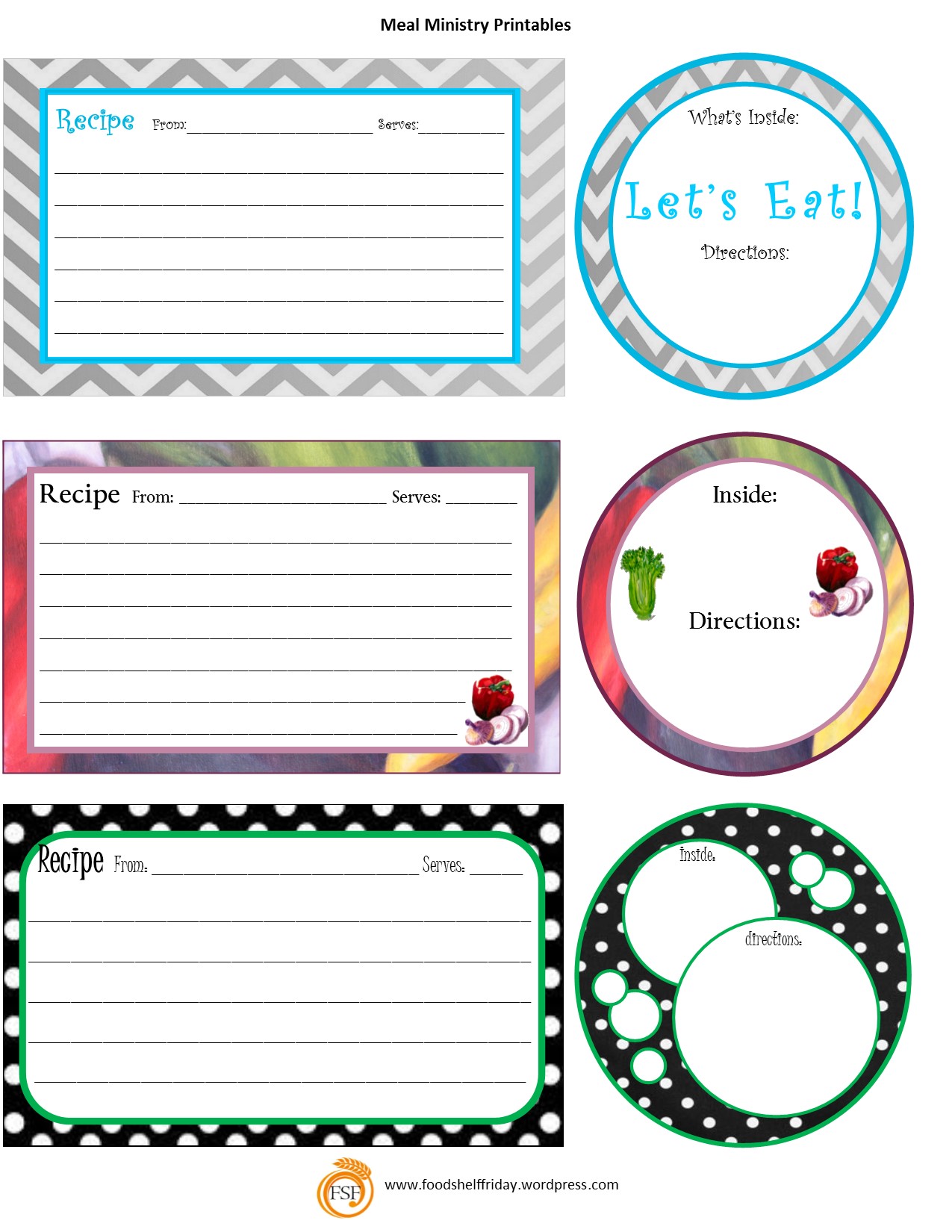
At the bottom of this post is a free printable – some cute Meal Ministry labels and matching recipe cards. Feel free to print and share (they’ll work best on medium weight white cardstock).  I pinned a bunch of blog posts and recipes about Meal Ministry to the Food Shelf Friday Pinterest account.  Click HERE for those links, including more printable labels.

Above all an attitude of service and sensitivity are the keys to successfully blessing others with meal ministry. Now go out there and be a blessing! Remember if you have other ideas to add to this topic, or a great meal ministry recipe, share it in the comments!

printables for meal ministryprintables for meal ministry