Organization Profile: International Justice Mission

IJM

I wasn’t planning to bring you another organization profile this week, so soon after the FMSC profile, but when I woke up this morning, the first thing I saw was a friend’s retweet about an International Justice Mission (IJM) lawyer, his client, and a taxi driver who were kidnapped in Kenya. IJM was asking its supporters to use social media to make the Kenyan ambassador aware of the kidnapping and move him to help the investigation along. I added my voice to the chorus by posting my retweet, and I decided to use today’s blog post to introduce you to IJM.

Because of the underground nature of the offense, as well as the varying definitions of “modern slavery” and “human trafficking,” there is no concrete number of people enslaved in the world today. In a 2014 report, the U.S. State Department put the number at around 20.9 million people. The Global Survey Index puts the estimate at 35.8 million. Other estimates run even higher. Only God knows the actual number, but whatever it is, it’s too many. Even one is too many.

I could go on and on about how our wasteful love of cheap commodities and industries like fast fashion and pornography fuel this problem, but I really want to talk about the heroes, not the villains. International Justice Mission is one such hero. They are the largest justice organization in the world. IJM has 17 field offices around the world, and they work with the governments of developing nations to insure that all people are treated fairly and allowed to live free.

IJM’s focus is on fixing broken systems by providing resources and training for local law enforcement and advocacy and hope for victims. They physically rescue people living in slavery, work with social services to see people restored to their communities in a safe and healthy way, push for the prosecution of criminals, and provide legal services to the falsely accused.

It’s a big organization with a lot of irons in the fire, but it is extremely well run. International Justice Mission is rated “gold” by GuideStar, and is a Charity Navigator four-star organization. Their financial reports from the past five years are available right on their website. IJM’s CEO, Gary Haugen, has a background in human rights prosecution with the U.S. State Department. He founded IJM after working on the Rwandan genocide for the State Department and realizing that the world needed more people fighting injustice and violence against the powerless.

If you’re interested in the cause of human trafficking or modern slavery, the IJM website has many useful links and resources. I highly recommend them as a source of information, and they are an excellent organization to support with your finances and prayers. Follow them on Facebook and Twitter so you can raise your voice for awareness as well!

My Hunger “Bucket List”

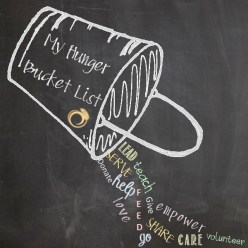
My Hunger Bucket List

Are you familiar with the concept of a “bucket list?” The idea is just a list of things you really want to accomplish before you “kick the bucket.” Some people have a literal checklist, but most of us just have general ideas. For example, my bucket list includes visiting Paris (I studied French in high school and college), to see the Eiffel Tower and the Mona Lisa in person. Even if you’ve never heard of a bucket list, I’ll bet you’ve dreamed about things you want to do before you die.

I have a Food Shelf Friday bucket list as well – things I want to do or experience as I advocate for the world’s hungry. So today, I’m going to share those dreams with you.

  1. Meet my Compassion child: I’ve told you before about my friend Edouard, whom we sponsor through Compassion International. One of the great things about Compassion is that they can also arrange for you to meet your sponsored child if you visit his or her area. They even plan missions trips a couple times a year and take sponsors to different parts of the world to serve and meet their kids. They just went to Burkina Faso last year, and Edouard is pretty young yet, but I would really love to do this when he’s older and we have more history together.
  2. Build and maintain a revolving portfolio of microfinance loans: Microfinance is another topic I’ve covered previously. At the time when I first shared this revolutionary tool, I also made my first loan through Kiva. Loans pay back in five years, and the money can be reinvested in another loan at that time or cashed out. My plan is to make a new loan twice a year (December and April), until I have ten loans out there. At that point the first one will pay back and will fund the 11th. My investment, built during the first five years, will become a self-feeding revolving portfolio of investments. Of course, not all loans successfully pay back, but the occasional failed loan can be replaced by a new investment on my part. Now, that may sound like a lot of business mumbo jumbo, but it’s not as elaborate and complicated as it seems. Kiva does all the work for me; I just invest about $30 at a time and pick a project that I would like to fund. So far, my first two loans have been agricultural and seem to be loans that will yield long-term opportunity for the lenders.
  3. Transition my wardrobe from “fast fashion” to fair trade: Like microfinance, fair trade is a long-term, sustainable way to provide opportunity, and thus poverty and hunger relief, for people around the world. I am determined to care for my wardrobe, making things last as long as possible, and to replace things (when needed) with items that were made with fair employment practices that empower rather than imprison the workers.
  4. Continue to develop a personal reputation for serving others: When someone has a need for volunteers, I want them to think of me. Not because I want the recognition, but because I want more opportunities to love and serve. I want my life to be an offering to God, and for Him to put me to work loving and serving others the way Jesus did.
  5. Develop Food Shelf Friday’s reputation as a resource: Bloggers try really hard not to get caught up in the numbers, especially faith-based and non-profit blogs. We’re torn between wanting God to build His kingdom as He sees fit, and peeking at the stats to see if we’re doing a good job.
    It’s really not about the numbers, anyway. I would rather have a hundred people know about Food Shelf Friday if it blesses and informs their efforts and service than to have a million followers who don’t read the blog, or only come here for a laugh.
    And yet… I feel that this blog is something God has called me to do, and that the information I offer here is valuable. It does no good if I share it with an empty room, right?
    So as you can see, it’s a back-and-forth debate. In the end, I do care if people read my blog, and I work hard to build a social media following, find opportunities to write for other publications, and provide you with well-researched and interesting content. I really want Food Shelf Friday to succeed, and I want it to be a tool that you use as you make decisions about your lifestyle and plans to serve those in need. I repeat (as I often do) that I will NEVER use guilt and sad pictures to prod you into action. Your motivation should come from your own beliefs and the spirit’s convictions. Food Shelf Friday is just a tool to help you act on those convictions. You should never have cause to fear what you’ll see on this site or on my social media feeds.


Obviously I have a ways to go. Hopefully I’ll have many years to reach and refine, and I’m sure I’ll come up with many more dreams as well! Leave a comment with some of your bucket list dreams (personal or service-based), and/or topics you would like to see covered here on Food Shelf Friday. I welcome your feedback!

The Elimination Diet

Elimination DietFriends, I’m being tortured. After seven years with eczema and trying every medical and holistic treatment on the planet, we’ve moved into the realm of unholy torture. They put me on an elimination diet.

What is this torment, you ask? Well, let me tell you. I am allowed to eat virtually nothing for three weeks, then I reintroduce foods one at a time to see if they trigger the eczema symptoms. All I can eat is turkey, organic chicken, fish, brown rice, quinoa, and fruits and veggies (except for grapes, bananas, citrus, strawberries, tomatoes, potatoes, and peppers. Those are taboo as well). I’m half way through the 3 week phase, and next week I’m reintroducing beans and peas (other than soy). Some people don’t even eliminate those, and I have no reason to think they would be part of the problem, so they get in early.

I have two real fears about this process. First, of course, I fear that I will learn that one of my favorite things in life, like gluten or cheese, has to be permanently eliminated. I am seriously considering whether some things are worse than eczema… Second, I fear becoming one of those whiny crusaders who ruins every event by talking incessantly about their dietary issues (yet, ironically, here I am blogging about it. I promise it won’t become a regular occurrence). I resisted the elimination diet as long as I could because of these two things, yet here I am.

Once during the first week, when I was still reeling from the limited scope of my eating options, I decided to roast a turkey. I got the bird all thawed and ready to go, put it in the oven on time bake, and headed off to work. When I got home that night, I was instantly alarmed by the lack of turkey smell in my house. I ran up to the kitchen and found that the oven’s time bake and computer bits had frizzed out (that’s the technical term, I’m pretty sure). The turkey was raw, and it was time to eat. To add insult to injury, my microwave had bit the big one just the day before. I could eat nothing at restaurants, I could make nothing in the microwave, and my son had to get to church. I threw something together for my husband and son, and settled on a can of tuna, some sour kraut, and asparagus for me. That has to be the weirdest menu I have ever put together, but I just had to make it work. I posted the story in a group on Facebook, and one of my friends commented something like, “May I gently remind you that you advocate for the hungry?”

She’s right. An elimination diet is frustrating, and having things go wrong when you had a plan is also frustrating, but it’s nothing like what people face when they are truly hungry. I have options, though they’re fewer than usual and sometimes strange. The hungry have no options. If tonight is a disaster, I will eat again in the morning. The hungry probably won’t. While my microwave was down (the new one came today), I had my gas stove to cook on. In many parts of the world, making a hot meal requires foraging for sticks to burn. I still have a lot to be thankful for.

That dinner disaster, and my friend’s sweetly offered wisdom opened my eyes. I know that whatever I learn from this diet, it will not ruin my life. There are thousands of foods available to me. And this mindset, I believe, will help me to not become one of those diet-obsessed oversharers.

Edited July 16, 2016 to add: I survived! My eczema is doing better, and I discovered that my main trigger is eggs (not a surprise since my son was allergic to them too). Thank you to all my friends who supported me during the process 🙂

Organization Profile – Feed My Starving Children

FMSC.jpgHappy Friday, friends! It’s setting up to be a hot weekend here in Minnesota (yes, really, we have those. It’s going to be humid and in the 90s). I plan to beat the heat by spending the weekend at work, as I usually do, and going to small group on Saturday. I’m also working on my son’s Scouting scrap book in preparation for his Eagle Scout court of honor coming up in August. I hope that wherever you are you are keeping cool and doing something fun this weekend.
For today’s post, I’m going to share another of my favorite organizations with you.

Feed My Starving Children
http://www.fmsc.org
Charity Navigator – 4 Stars

I first became aware of FMSC because they have a food packing facility near my home, and we went there as a work group back when I was doing childcare at a gym. I loved their mission to feed hungry kids around the world and the opportunity to participate hands-on by packing meals.

When you visit an FMSC packing facility or mobile pack event, you participate in manufacturing one of three nutritionally complete meal options. The most common, and my favorite to pack, is the original Manna Pack. They also make two potato-based formulas, Potato-W and Potato-D. The potato formulas meet the specific nutritional needs of weaning babies (W ), and people with chronic diarrhea (D), a serious and life-threatening condition for the malnourished. The reason I prefer packing Manna Pack is because the potato powder, the basis for the other two formulas, floats in the air and sticks to everything, including your skin and clothes. It doesn’t hurt anything and it washes right off, but I still prefer original Manna Pack.

fmsc meals

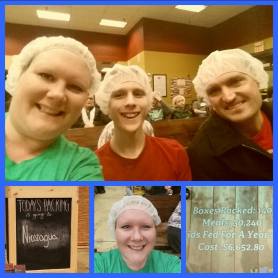
Manna Pack consists of vitamins (a vegetarian, chicken-flavored vitamin powder), vegetables (dry veggie bits), soy* (a brown, crunchy, cereal-like puffed soy), and rice. Volunteers in hairnets and gloves gather around a table to fill bags with carefully-portioned amounts of each ingredient. They weigh the bags, and pass them off to a sealer (my favorite job), who pops the bag closed, removing as much air as possible, and seals it shut using a commercial sealing press machine (the sealer has to be 18+). A boxer (J’s favorite job) at each pair of tables boxes up the meals, keeps a tally of the boxes finished by his tables, and calls out cheers to keep everyone having fun and to let the warehouse volunteers know that they need to come get another completed box.

FMSC’s nutritionally-complete meals are paid for my donations, and packed by volunteers, and each meal costs less than twenty-five cents to produce. The boxes of food are loaded onto pallets and shipped to partner organizations around the world. These partners use the FMSC food in their various missions feeding orphans, refugees, and hungry children around the world. For example, some of Venture‘s work uses FMSC meals.

Packing sessions at FMSC take place six days a week, daytime as well as evening. A packing session lasts a couple of hours from the orientation rally to the closing (optional) prayer over the pallets (FMSC is a Christian organization, although they do not require you to have any faith connection to come and pack nor to receive meals). Children five years and over can participate, though there are rules for how many kids/per adult you can have in your group (and that number varies depending on the kids’ ages). You will have to wear a hairnet the entire time you are at the packing facility, and you cannot wear any jewelry, so it’s best to leave that at home. You can get more information on packing locations and rules on the FMSC website.

If Mobile Pack is coming to your area, or if you live near a permanent facility, I highly recommend you donate and/or try packing meals at Feed My Starving Children. It’s a great experience and a free outing for the whole family (or small group, book club, work group, birthday party, etc.). The organization is reputable, and their work (YOUR work) is life-saving.

fmsc feb 2016

Have you packed meals at FMSC or another similar organization, or worked with a partner organization that distributes the meals to hungry kids? Tell us about it in the comments!

*Please note that soy is used throughout the facility, so if you have a serious soy allergy, you should probably confine your support to financial giving. If your soy allergy is mild or limited to actually eating soy, you can go to a packing event. The staff will put you to work labeling bags or something of that nature away from the packing room.

Nervous: Facing Need Head-on

Nervous

About a million years ago, back when I first started my undergrad degree, I took a public speaking class. It was good for me. I went into it afraid, and came out far more confident in my ability to speak in front of a group. One of the things our professor taught was that you never tell the audience that you’re nervous. “If you’re nervous, they can already tell,” he would say. “And if they can’t tell, you should let them keep that illusion.” He pointed out that once you tell the audience about your nerves, they start to see your nervousness instead of your message.

Rules were made to be broken, right? I’m nervous writing this post. I’ve learned something about myself and I don’t like it. Worse than that, I’m afraid of the consequences of changing. I’m afraid that by telling you and admitting it to God, I’ll be held accountable to change.

You all know that I care deeply about the world’s hungry. I love service projects, volunteering, and supporting great organizations. But hands on, face to face with need, I’m terrified. I like my service projects, volunteering, and support to be clean. I like to pack meals at Feed My Starving Children. I actually enjoy serving in the kitchen during church events. I’m overjoyed to speak to the middle class and church people. I’m happiest doing research and writing about best practices and great organizations here at Food Shelf Friday. But making a small sacrifice here in my safe, clean home is one thing. Coming face to face with need on the streets and the uncertain mental and moral status of individuals feels dangerous and threatening.

We finally gave away our last “blessing bag” this week. J and I enjoyed planning out the bags, shopping for the supplies, and preparing the packages. But handing them out was unnerving. The first bag I handed out was on a busy urban street corner in broad daylight. I was alone. As I approached the intersection where a man stood with a cardboard sign, I realized he would be on my passenger side. I grabbed my purse and put it on my lap, grabbed the bag, and opened the window as I approached.  “Here are some things for you,” I said. He thanked me, and I waved as I pulled away, heart pounding. The second bag went to a man on a highway on-ramp. It was a public but less busy area. Again, I moved my purse away from the window, rolled it open, and handed out the bag. Again, the man thanked me, and again my heart pounded as I pulled away.

Several months passed after that encounter (Minnesota winters aren’t really conducive to street corner begging). I realized a flaw with the blessing bags – they were only helpful if I was in my car and if the people in need were somewhere I could reach from my lane. Most of the time I see people begging when I’m not in my car. After being approached on a light rail train, I realized that I needed something more portable. So I picked up a couple of $10 Subway gift cards. I chose Subway because they offer reasonably healthy food, and because they don’t sell alcohol. If someone wants to sell the gift card and use that cash for alcohol, I can’t stop that, but I feel like this gift card offers something truly useful. I won’t accidently spend the gift cards, as would likely happen with cash, and they’re so portable I can carry them in my phone case at all times.

This past weekend we saw our third blessing bag recipient. This time J was with me, so as I approached the intersection, I instructed him to grab the bag and open his window. He was immediately nervous and flustered. As he handed out the bag and settled back into his seat, I noticed two things. First, I wasn’t nervous. Either the recipient being female, the fact that I wasn’t alone, or the fact that I was the driver and not the hander-outer was apparently enough to keep me from getting nervous. The second thing I noticed is that J was worked up. “That was scary,” he said several times on the way home.

Ok. So apparently it’s not just me. Why do we get scared? I know one thing that worries me is the unknown mental state and motives of the stranger. One day when I was driving home from work, I was spending some time in prayer, and I offered God my willingness to do anything He might call me to do. “…except picking up hitchhikers. I’m sorry Lord, but the only way I will ever let a strange hitchhiker in my car is if he looks exactly like the Jesus of Renaissance art and holds up a sign that says, ‘Hey Karah, this is Jesus, give me a lift.’ And even then, Lord, I’m not sure I could do it.”

I’m afraid because as a woman I have heard stories my whole life (mostly fiction and Dateline-style news drama) about female joggers dragged into the woods and back alley assaults on women out after dark. Jacob Wetterling, Elizabeth Smart, Jacycee Dugard – their stories are part of our collective memory. They scrape away our faith in humanity, our personal security and confidence, and our willingness to “get our hands dirty.” We want the police and missionaries to handle it, and we’ll just take up an offering or hold a supply drive.

Sometimes that’s ok. I don’t want my sweet grandma to start working with bikers or even to answer the phone when scam artists call. I don’t want my teenage son rehabilitating reformed prostitutes (God forgive me for even saying that…). And offerings and supply drives make many amazing ministries possible. Some things are just not appropriate, and some situations need to be handled by people with special training.

But I do not want to be afraid of people. I want boldness and confidence in the God I serve. I want to bless others and not always hide and distance myself from need. I want to learn to love people because God loves them. I want to overcome my nerves because I know that I am called to serve and advocate on behalf of the hungry.

There, I said it.

Do you identify with this discomfort/anxiety? Have you overcome it? What worked for you? Share in the comments!