Finding Balance: Nutrition vs. Non-perishables

balance

Take a look through a grocery aisle of canned goods or a glance at your own home pantry, and you’ll notice that non-perishables aren’t the healthiest foods. In order for them to keep long-term, they’re packed full of sodium and other preservatives, and they tend to run a little light on nutrients. But there are things that we can do to maximize the nutrient value of our food shelf donations.


  1. Choose whole-grains: White rice and pasta fill your belly and provide energy-giving simple carbohydrates, but not much else. Complex carbohydrates from whole grains have a lot more to offer, like higher amounts of fiber, selenium, potassium, and magnesium.
  2. Watch out for sugar: If you’re a label-reader, you know that they put sugar in EVERYTHING! Some sugar is natural, of course, but a lot of it is added and unnecessary, and most Americans eat way too much of it. They put sugar in ketchup, salsa, salad dressings, cereal, juice, and canned fruit. It can really add up! Read labels, for yourself and your food shelf donations.

    heinz-ingredients-toxic-mercury
    Ingredient list from a name-brand ketchup bottle
    (also note the sodium. 160 mg just for a condiment!?!)

  3. Choose low-sodium options: Like sugar, sodium is in everything, and most of us are getting way more than is healthy for us. Sodium is added to canned goods as an inexpensive preservative. It’s an important nutrient the body needs to regulate hydration, but too much can cause, or at least exacerbate health conditions like high blood pressure and heart disease. Avoid donating high-sodium, low-nutrient foods like ramen noodles, and instead pick reduced-sodium foods with nutritional value, like vegetables.

    top-ramen-nutrition-facts-ingredients1
    Nutrition label from ramen noodles

    Green-Beans
    Image borrowed from fitness blog http://www.howdoigetripped.com – clicking the image will take you to the original source.

  4. Support food shelves that offer fresh foods: Obviously, if you live in a small town there probably won’t be a variety of food shelf options, and operations of all sized offer valuable services that deserve our support. But in most metropolitan areas there are food shelves that offer more than just canned goods. Bigger operations offer fresh veggies and meats, breads, baby care items, and more. If possible, support food shelf efforts to provide their clients with nutritious foods.


Eating a healthy diet when you depend on the food shelf’s non-perishable offerings is a challenge, but mindful donors can take steps to minimize the supply of salt- and sugar-laden canned goods and instead offer more nutritious fare. Share your additional ideas and experiences in the comments!

A Brief History of Welfare in America

brief history of welfare

This week I listened to another audiobook courtesy of the Overdrive app and my local library. If you have a smart phone, tablet, or e-reader, I highly recommend you ask your local library if they have the Overdrive app available. There are tons of audiobooks and e-books you can check out for free.
Anyway, when I was scrolling through audio titles recently, I came upon a book called $2.00 A Day: Living on Almost Nothing in America by Kathryn Edin and H. Luke Shaefer. My first response to the cover material and introduction was skepticism. For as much as I know about poverty and hunger, I still did not believe that this extreme level of poverty was possible in America. Between SNAP, Medicare/Medicaid, Social Security Disability, welfare, WIC, private charities, and private donations, I could not believe that there were people with no job AND who were turned down from these social security nets.

As the authors, a sociology professor and a social work professor, began to unwrap their research, I could see the pockets of this level of destitution that exist here in the United States. I still had trouble finding sympathy for some of the subjects because of their terrible life choices. The authors did not go digging for the most innocent victims of poverty, to be sure. I am also not completely sold on some of their conclusions. Their plan involves a lot of expansion in government services and job creation, yet they offer few if any suggestions about how to fund such programs.

But feelings and solutions aside, the most valuable part of this book in my opinion was the historical context it gave to American welfare programs. So using this book as my source, today’s post is a review of that history.

The Great Depression
Prior to the Great Depression in the 1930s, government welfare programs were virtually unheard of in the United States. But when things got desperate, President Franklin Roosevelt enacted several pieces of legislation aimed at putting Americans back to work and providing for those who were unable to care for themselves. Many of the programs (such as the Works Progress Administration which put Americans to work on public works programs) expired or were discontinued when the Depression ended. Others continue even to this day, including Social Security for the elderly and disabled, Medicare and Medicaid health insurance. One of the programs that came out of the Depression era was Aid to Families with Dependent Children (AFDC), commonly known as welfare. AFDC provided a cash safety net for families with children who found themselves in a desperate situation.

The Great Society
In the 1960s, President Lyndon Johnson greatly expanded social service programs, including AFDC, as part of his “Great Society” initiatives. Johnson’s goal was to eliminate poverty and racial inequality in America through a series of legislation which expanded existing social programs like Social Security, AFDC, food stamps, and Medicare/Medicaid. It also created Head Start, the National Endowment for the Arts, the National Endowment for the Humanities, and the Department of Housing and Urban Development (HUD).

The 1970s and 1980s
Reaction to the Great Society programs were mixed. While it provided tremendously for struggling Americans, many felt that it rewarded indolence and unwed procreation. Edin and Schaefer argue that welfare was widely unpopular after the Great Society because it was at odds with deeply held American values like self-sufficiency, the primacy of family, and the value of hard work. They site a study where the majority of Americans in a survey group stated that they believed that the government was not doing enough to help the poor, and in the same survey they responded that welfare was too expensive. Americans were concerned that welfare was trapping people in a cycle of dependency, and they complained of costly abuses of the system. Ronald Reagan made welfare reform a campaign issue in the late 1970s, and the popular support for welfare reform helped get him elected.
Also during this time, the food stamps program was renamed SNAP, and a program using an Electronic Balance Transfer (EBT) card rather than paper food stamps was instituted to cut down on the (illegal) sale of food stamps, a popular survival strategy for people with no cash income.

Welfare Reform
For all the rhetoric, Reagan was not able to push though significant welfare reform. The issue continued to be a popular campaign topic but difficult to enact. In 1991/92, Democratic Presidential candidate Bill Clinton took up the mantle, promising to “end welfare as we know it.” Once elected, President Clinton set out to reform the welfare system using aspects of a plan proposed by Harvard professor Dr. David Ellwood. Elwood’s plan proposed a system that encouraged work through a combination of cash welfare and job training, with limits on welfare that would encourage individuals to wean off the system and guaranteed jobs in government if nothing was available in the private sector. As the various welfare bills made their way through committees, the House, the Senate, and onto the President’s desk (where two welfare reform bills were vetoed), the legislation looked less and less like Ellwood had imagined. The final result was the Personal Responsibility and Work Opportunity Reconciliation Act of 1996, which virtually eliminated welfare as we knew it and instituted a new work-based program. It replaced AFDC with Temporary Assistance to Needy Families (TANF), a program that supplied cash welfare with strict time limits and work requirements designed to prevent long-term welfare dependence. The results have been mixed. Proponents are quick to point out that the welfare rolls have shrunk dramatically, but opponents point out that the number of families suffering from lack of resources, and the strain on private charities have increased as a result of the reforms.

The System Today
The TANF program was reauthorized in 2005 with slight adjustments. Following the advent of the Great Recession in 2008, Congress enacted the American Recovery and Reinvestment Act of 2009, a temporary addition to TANF designed to get Americans through the recession. It provided a temporary TANF emergency fund (2009-10) as well as jobs programs aimed at stimulating the economy and improving American infrastructure through public works programs.
In 2010 the TANF program was reauthorized for a second time.

It’s not easy to tell the whole story of American welfare in 1000-ish words. I know this does not cover every argument for and against the programs. But it does provide you with a basic understanding of how we got to where we are today. Edin and Schafer argue that the old system was out of sync with American values and full of holes, but they also argue that the current system leaves many people with few legal options. They propose further reforms that focus on wage and workplace protections, and work opportunities, among other ideas.

This feels a bit scary, like opening Pandora’s Box, but if we agree to be civil I think we can have this discussion. What POSITIVE changes would you like to see in the way the federal government treats the poor? More mental health services? An increase in the minimum wage? Leave a comment!

Book Review: Kisses from Katie by Katie Davis

Book_Review_template

This year for my birthday, my sister gave me an Amazon gift card. I went a little crazy… I bought 6 used books and 1 new one. I only overshot the $25 card by a few dollars (I love cheap used books…). As they began to arrive in the mail, I set up a schedule for all the books I would read this summer. I planned a month of Food Shelf Friday book reviews. But, you know, that dang thesis is still hanging over my head, so reading anything else has to wait…

One of the books I ordered was Kisses from Katie by Katie Davis. I knew very little about it, other than that some of my friends had recommended it, and that it was about an American young woman who had gone to do mission work in Africa. The day after my book arrived and was added to my growing “after thesis” stack, I got an email from the local library that per my request, they had added the audiobook of Kisses from Katie to their e-reader app. Yay! Audiobooks mean I don’t have to wait until my thesis is done; I can start listening right away while I commute! So this week, while driving, mowing, and doing dishes, I worked my way through this incredible story.

As previously mentioned, this is the autobiographical story of Katie, a young woman from the United States. Katie is a Christian, and she had a heart for people. As a senior in high school, Katie and her mom went on a short-term missions trip to Uganda, where they worked with babies and toddlers in an orphanage. Katie fell head over heels in love with the area and the people. After graduating from high school she went back to Uganda to spend a year working with kids there. Things took off in ways she never could have dreamed. By the end of the year she was foster parenting a dozen little girls, and had started a non-profit organization to provide education for kids whose parents cannot afford the fees required for school. Not bad for a teenage girl, right? As you can imagine, Katie decided to make Uganda her home.

The book covers her first two years in Uganda, and it primarily an outline of her faith journey during that time. It’s full of deep thoughts about the love and provision of God and the call to lay down our lives for His plan. Katie’s story goes by fast, and I imagine it felt that way to her too. After all, we’re talking about a teenage girl moving to another continent, adopting a huge household of children, and starting a ministry all within a year or two. The stories were sometimes hard to hear, and I shed more than a few tears.

It feels like Katie doesn’t have a plan; she just does the next thing that comes up. Maybe that’s her writing style, and maybe it’s true; she certainly seems to have the faith to just keep going through one thing and then another. For me as a planner, that was a bit stressful. I wanted to know where she got the training and supplies to do basic medical care, where and how she shopped for the tons of food she needed to feed her growing household and all the kids that came over for baths and meals.

As a reader, I wished for more detail on the practical side of things. How do they fit two women and (eventually) fourteen girls in a four-bedroom house and still have room to take in guests? How often do Katie’s friends and family members come over to Uganda to visit and help? How does the foster/adoption system work over there, because there is no way the American system would let a 19-year-old kid take in over a dozen little girls.

I also wanted an update, and more pictures. The book ends in 2010, so I was curious about the last six years. After finishing the audiobook, I picked up my paper copy and did find a 2012 mini-update in the back. I was happy to learn more about two of her girls in particular (That’s all I can say – no spoilers!), and I’m sure some digging around online will help me find even more, because I know Katie blogs. I also wished for more pictures. Obviously the audiobook had none, but the paper copy only had a few, and those were tiny. There was no one picture of Katie with all her kids.

My overall impression is that Katie is a remarkably obedient young woman with a heart for God and for people. I laughed and cried, and I really enjoyed her insights, especially about God’s heart for orphans and the poor. If I had a tween/teen daughter, I would definitely give her a copy of this book, or listen to the audio together on a trip.

In a way, I envied her position far from American consumerism and fully dedicated to God and His work. I think the juggling act of American comfort and God’s compassion is tough. Trying to live different without selling all and walking away is hard. Part of me wants to give my life to serving, but the other part of me has a job I want to be good at, a home and yard I want to maintain, etc. Finding the balance between responsible budgeting and responsible fair trade purchasing is hard. Buying local and organic while also saving enough to invest in missions and ministries is hard. I just want everything, even though some it conflicts!

Katie addresses this in her book, and other writers have touched on it as well. They say it just takes faith and doing the best you can now, and then doing the next right thing. For me, it’s hard to accept the imperfections of my life and the truth that I will never get it all right. But a story from Rachel’s Tears (the book about Columbine High School victim Rachel Scott) helps me understand a little better. In her diary (the main source for the book), Rachel recounts a time when she was asked for help by a woman in need, but she felt that she couldn’t. Later she was feeling guilty for not helping the woman, and she felt the Lord explain to her that SHE wasn’t His only resource. He would take care of the woman in need, but Rachel was the one who missed out. We get so caught up in “how can I fix?” when what God is saying is, “I will fix. Would you like the blessing of being the tool I use?”

This is not to say we should go on being lazy because someone else will do it. Yes, God has more than one resource and He will provide, but we miss out on the real reason we’re here when we decline the opportunity to be used. We should be jumping at the chance to know the Father better by loving, serving, and giving side-by-side. You will not have the opportunity in heaven to introduce yourself to God. You should already be quite close by then, and if you didn’t get to know Him on earth, you missed your chance. Besides, we all know enough about statistics to know that not every orphan or starving child has a Katie. There is plenty of need for you and me too!

Have you read this book? Do you follow Katie Davis’ blog? Share your insights in the comments!

Mission, Vision, and Values

Reminder: We’re down to TWO DAYS to order the Nourish Hope necklace in time for Mothers Day! The necklace WILL continue to be available after that, but if you want it in time for Mothers Day, you must order before May 1. Whether you are ordering or not, PLEASE help us raise lots of money for Venture by sharing on social media. There are shareable posts on the Food Shelf Friday Facebook page and @Foodshelffriday on Twitter. Thank you!

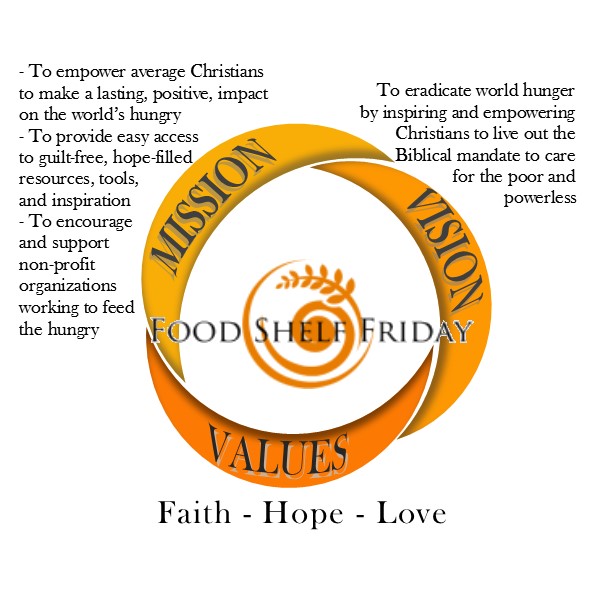
Mission Vision Values

I don’t have a regular post for you this week. I spent the last two days at a conference for work, I have been working diligently on my thesis (88 pages and counting!), and I’m going through a brand strategy course through Amye Still (it’s called Brand By Design, and it is helping me sort through all the dreams in my head and figure out exactly what God wants Food Shelf Friday to be and how I can get there. It has been great! If you have a blog, business, ministry, or MLM, I highly recommend it.) So, you know, time…

Anyway, this week in Brand By Design, we worked out mission and vision statements for our businesses/blogs. I gave a lot of thought and prayer to what Food Shelf Friday is and what God wants it to be. The image above shows what I came up with. The easiest part was the values – faith, hope, and love. I said to myself, “what do I value as Food Shelf Friday?” and it was just there. I value faith; it’s the heart of why I advocate for the hungry – because caring for the poor is what God requires of us and because I want them to have a chance to know Christ. I value hope; I don’t believe that God is glorified in guilt, and I always strive to encourage and empower people through positive, hope-filled means. Without hope, we’re defeated, just tilting at windmills. Because we have hope, it fuels us. And love – loving God and loving people is what life is all about. So that was a no-brainer. The rest of the wording took a bit more effort…

So that’s what I’ve been up to this week. I promise to bring you more “meat” next week. I’m in the middle of an audio book right now that will become a book review post soon, and I bought a pile of books with a birthday Amazon gift card from my sister, so expect to hear from some experts this summer. I also have a whole brainstormed list of projects and ideas, so there’s lots to look forward to. Thank God my thesis is almost out of the way…

Have a great week!

What is Crowdsourcing? And how do I find the right site for my campaign?

Crowdsourcing

I talked in a previous post about microfinance loans – a bunch of donors each giving a small gift/investment so that people in need of small loans and those with little to no access to capital can have a chance to borrow money for investment in their ventures. Economists believe this access to capital is better than a handout for building sustainable economies and empowering people to improve their lives.

Another way to raise capital is crowdsourcing or crowdfunding. Crowdsourcing is a campaign via a website, that backers can contribute to in any amount they can afford. Unlike microfinance loans, most crowdsourcing is not paid back, but you do have to offer some kind of freebie for donors at different levels. It is more of a handout or fundraiser than a loan like microfinance, but it often serves the same purpose of bringing a smallish infusion of capital into a project. Here in the U.S. crowdsourcing has been used by individuals (for things like adoption fundraising, medical/funeral expenses, or educational expenses), non-profits, self-publishing/producing of books, music, or movies, and business start-ups. It has even been used for some ridiculous things. Last year there was a guy asking for money to learn how to make potato salad. Sometimes the absurd works out; he made a good deal of money (THOU$AND$!!!). Crowdsourcing for an individual or business has the added complication of dealing with the IRS, but for non-profits it’s simpler because they can accept tax-deductible donations.

There are a number of crowdsourcing websites out there, so if you’re thinking about doing a campaign for something, be sure and do your homework. And prepare yourself for some hard work; you don’t just click a few buttons and watch the cash roll in. You have to manage and advertise the campaign to get people’s attention (and their dollars!), and you have to offer some kind of freebie they actually want.

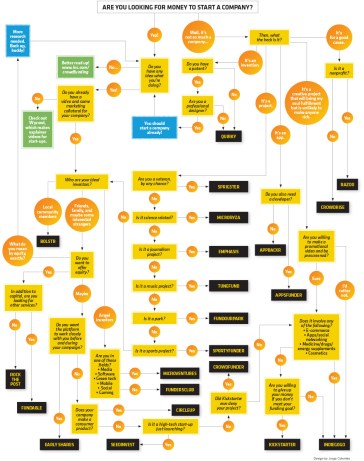
Inc Magazine had this map to help you find the right crowdsourcing site. My image here is small, but if you click on it you’ll be redirected to their original article and the full-size image.

inc-magazine-crowdfunding-infographic-june-2013_26652.jpg

Another source for information is Crowdsunite – they offer information on the different crowdsourcing options and allow you to narrow the list and find sites that fit with your needs.

My personal experience with crowdsourcing is pretty limited. At the museum where I work, we had an Indigogo campaign to try and raise funds for an event, but after a week without a bite, we received word that a private donor wanted to fund our project, so we cancelled the campaign. I’ve also donated to a few campaigns by friends who were raising money to adopt and (nerd alert!) to help the guys at RiffTrax fund an MST3K reunion show. But I have seen it make a huge difference for people when it’s done well.

Have you ever raised funds through crowdsourcing? Tell us about your experience in the comments!