What NOT to Donate to the Food Bank

What not to donate to the food bank

When my son was little, we passed the time on car rides by playing little games. One of his favorites was called, “You can’t eat that!” We would take turns naming things that you cannot eat, and then we would giggle about the silly notion of eating things like crayons, cars, and zombies with flamethrowers. Obviously I have only myself to blame for the sarcastic funny man my son has become. We’re like mediocre improv comics, or really bad Family Feud contestants (except we’re doing it on purpose. Seriously, click HERE for a YouTube video of some of the worst Family Food answers ever. Fair warning, it’s PG-13, so preview before you decide about showing it to the kids.)

In that spirit, we bring you first the funny and then the real
What Not to Donate to the Food Bank:

A piñata full of canned goods (ouch…)
Little refill packets for your E-Z-Bake Oven
Canned giraffe meat from your cousin the poacher
Plastic toy groceries from the kids’ play kitchen
Lotto tickets (unless it’s a big winner. No one would turn that down…)
Neked Grandma (if you watched the link above, you’ll get it)

Random items that no one in their right mind knows what to do with: You’re feeding the hungry, not cleaning out your fridge. Most food shelves have a set assortment that they give to each person who comes to them (cereal, canned fruit/veggies, dinner mix, etc.). Your random jar of pickled pig’s feet gets tossed in a bin of extras they can pick through, and most likely ends up in the dumpster when it expires, unclaimed. I understand that giving away what you can’t or won’t use is better than throwing it out, and someone out there may like pickled pig’s feet and be grateful for them. I’m not saying you should only stick to the stuff on the MOST WANTED LIST, but there is something condescending about using the food shelf as your trash can, giving only the junk you don’t want. Loving the hungry is about being thoughtful and intentional, not about brushing off your crumbs on the “little people.”

Expired food items: Yes, canned goods are “non-perishable.” No, they’re not really eternal. Many canned foods have an expiration date and past that date their safety and flavor may be compromised. Food banks cannot hand out expired food, and furthermore they have to pay someone (if they don’t have volunteers on the job) to sort through donations, checking expiration dates, shelving the useful, and disposing of the expired or damaged items. The human resource is an expensive one, don’t waste it.

*Also, understand the difference between a sell by or best by date and an expiration date. Manufacturers put the sell by/best by date on goods for the stores’ inventory process (and as a bonus to their sales numbers, it tricks many of us into throwing away perfectly good items and then repurchasing them.). The expiration date is a safety issue. Botulism is a potentially life-threatening, tasteless, odorless toxin that can grow in canned goods and isn’t killed by cooking the food. It’s not something to mess around with.

Home canned goods: Food shelves don’t accept home canned goods for the same reason they don’t take expired items – they just don’t know about the quality and safety. Home canned items don’t have an expiration date, they’re not labeled for nutrition and ingredients (read: possible allergens), and they’re easily contaminated by preparation in the same kitchen where you cook with flour, soy, nuts, and other common allergens that, even in tiny amounts, cling to jars from the same kitchen. If you garden and can like I do, use your bounty to cut your own grocery bill, freeing up money you can donate to the food shelf. If you have a bumper crop, share the wealth with family, friends, and neighbors. Offer them a jar of your spectacular preserves in exchange for a non-perishable item for the food shelf.

*Likewise, food shelves can’t take items without their labels. They need to know what’s in that can and when it expires. They also cannot accept cans that are significantly damaged. A dent, sure, but open packaging and cans with busted seams have to be tossed.

Over-the-counter (or prescription) medications: Food shelves are simply not equipped to deal with this sort of thing. Plus, some over-the-counter meds are ingredients in meth, so having them around is an added security issue for the food bank (that’s why some things are locked up at the pharmacy or stored behind the counter). There are other non-food items that many food shelves will accept such as diapers, baby wipes, feminine hygiene products, and personal hygiene items like soap and deodorant.

I am thankful for each and every person who gives from their comfort or their poverty to help another. From a dented can of corn to a million dollar check, every single gift is precious in God’s eyes and important in the fight against hunger. The point of this post is not to put a damper on anyone’s giving, but just to give you information on what to expect and why some gifts have to be turned down. It’s not that they’re ungrateful; the food banks’ policies and procedures are in place to protect them and their clients. When in doubt, ask. Food shelves are happy to answer your questions about donations.

The Precious Burden: My Struggle to go ‘all in’ for the Hungry

Precious Burden

There is no denying that kids, even the smart, well-behaved, happy ones, are challenging. Some years back my son decided that he didn’t like caramel. My guess is that he tried a candy bar he didn’t like and threw that baby out with the bath water. About that time I re-discovered a childhood favorite recipe, monkey bread. If you don’t know monkey bread, it is refrigerated biscuit dough cut up into small pieces, tossed in cinnamon sugar, and baked in a Bundt pan with a delightful brown sugar and butter combo that becomes ooey gooey caramel.  When you invert the pan, the caramel fills the cracks between the soft pull-apart biscuit pieces. It’s delightful.

So the first time I made monkey bread for my little family, J turned a wary eye on its perfection and said, “Is that caramel?  I don’t like caramel.” In that moment I had a choice; I could admit that it was in fact caramel, keep the monkey bread for just the adults and rarely make it again (with just three of us in the house, if one doesn’t like something it goes on the more seldom rotation because we generate too much waste when things don’t get eaten), or I could find out in an I’m not lying, per se, I prefer to think of it as a psychological experiment kind of way if he did, in fact, dislike caramel. “No,” I replied, “it’s a brown sugar sauce.” The kid ate half the pan and asked me to make it again the next day.

At this point I had another choice to make. I could pounce on him with the revelation that he did like caramel, or I could keep it to myself. There was a lot at stake. If I revealed the truth he would probably stubbornly refuse to eat the monkey bread again. And I admit that I don’t mind being given the caramel portion of his Halloween candy. So I let it ride.

I love being a mom. My son is a definite highlight of my life. But sometimes he is a challenge. Kids whine, they talk back, and they cost a fortune to feed (Mine is 14 now. If yours are still little, just wait, soon they’ll obliterate your grocery budget). Kids make you worry like nothing else can. They are a burden, but a precious burden that is worth every minute of lost sleep and every dollar of expense.

That is the best metaphor I can come up with to describe my burden to feed the hungry. Every book I read, every website I research, every news report I see is a burden. My heart breaks a hundred times a day. I want to gather up all the hungry kids in the world and make them cookies. Or monkey bread. Now that I thought about that again I’m going to crave it for a week… I want to open my home, my pantry, my wallet. I know that the poor and the hungry are important to God and I want to show His love by serving them.

This burden is so heavy, but it is so precious. It gives me right perspective and adds a sense of value and purpose to my life. Like parenting, my burden for the hungry keeps me up at night and messes with my financial accounting. And I love it.

But I have only begun the journey of carrying this burden for the hungry and living a lifestyle of intention and focus on others. It’s a process. I can’t tell you how often I dream of putting more time and energy into feeding the hungry only to push aside God’s prompting with promises about getting to it after I finish grad school, or once this or that is paid off. I’m inching into the kiddie pool when I should cannon ball into the deep end. According to the UN, 21,000 precious people die of hunger and hunger-related illness EVERY DAY. They can’t wait for me to finish being entertained; I need to act on their behalf NOW.

That’s easier said than done, I know. Like you I have a mortgage, school debt, a car payment, etc. My home needs to be maintained, and I appreciate the importance of down time in a person’s life and date nights in a marriage. There are a lot of things to juggle. But a lot of them aren’t as important as I make them. I know I have a long way to go. I don’t want to wait and lug around this precious burden for no reason. I want to jump into the deep end and live a life that makes people a priority. I hope that, whatever your burden, you feel the same way.Thank you for caring for the hungry.

Please feel free to share your thoughts in the comments below.

Bonus: Monkey Bread

2 cans refrigerated biscuit dough
Cinnamon-sugar
1 Stick of Butter (1/2 cup)
1 Cup of Brown Sugar

Open the tube of biscuits and cut each individual biscuit into 3-4 pieces. Drop the biscuit pieces in a baggie, add some cinnamon-sugar, and shake to coat. Put the cinnamon-sugar coated biscuit pieces into a Bundt pan (non-stick or greased). In the microwave or on the stove top, melt the butter. Add the brown sugar to the melted butter and stir until combined. Pour the melted butter-brown sugar mixture evenly over the biscuit pieces. Bake at 325 degrees for 30-35 minutes, or until biscuits are golden brown. Let the monkey bread sit for about ten minutes, then invert the pan onto a plate (not plastic or styrofoam, those monkeys are hot, and you only make that melting mistake once…).

Double Bonus: Tonight’s FSF dinner, Cheesy Rice and Beans. My local food shelf gets a bag of rice, can of beans, can of tomatoes, and can of corn, and my family gets this tasty dish. Since I make my chicken stock from the bones of the chicken we eat (FREE, less wasteful, low sodium, no preservatives or mystery ingredients, I know the quality of chicken that went into it, and delicious flavor), the grand total for this meal and the matching food shelf donation is around $10

I got this recipe from the Cheese Pusher, and made a few alterations/corrections. See her original HERE.

1 Cup White Rice (or 2 cups Minute rice)
2 Cups Chicken Stock
2 Tbsp Olive Oil
1/2 Cup Chopped Onion
1 Clove of Garlic
1 Tbsp. Cumin
1 Can Black Beans, Rinsed and Drained
1 Can Whole Kernel Corn, Drained
1 Can Diced Tomatoes with Chilies (I prefer the tomatoes petite diced)

Toppings:
Cheddar or Mexican Cheese Blend
Sour Cream (or plain Greek yogurt)
Cilantro
Hot Sauce

Prepare the rice like normal, using the chicken stock in place of water. Meanwhile, heat the olive oil in a skillet and add the onions. Cook onions until translucent, then add the garlic for one minute more. Add the cumin to the onion mixture, stir gently. Add the drained beans and corn, and the undrained tomatoes to the mixture. When the rice is done, add the bean and veggie mixture to the rice and stir until combined. Serve with a generous amount of cheese, sour cream, and cilantro. For those who prefer more spice, add hot sauce to taste.

WIC (Women, Infants, and Children) 101

WIC 101

A couple weeks ago I posted about the American SNAP (food stamps) program. This week I’m going to give you a 101 look at another American government food program – WIC.

WIC is shorthand for The Special Supplemental Nutrition Program for Women, Infants, and Children. It is a program which specifically targets expectant, postpartum (up to 6 months post birth), and nursing (up to one year) mothers, as well as infants and children up to their fifth birthday. Proper nutrition in the first years of life is vital for mental and physical development, and WIC strives to get low-income kids a solid nutritional start.

The primary objective of WIC is nutrition.  They recognize breastfeeding as the best option for infants and support nursing moms during their child’s first year. For moms who can’t or don’t nurse their babies (No judgment here – my tongue-tied baby couldn’t nurse. We all do the best we can…) or who nurse but supplement with formula, WIC provides a high iron formula. If a baby has special doctor-prescribed dietary needs, WIC may provide special formula as well. In addition to formula, WIC provides vouchers for specific food items. According to the FDA website on WIC, “WIC foods include infant cereal, iron-fortified adult cereal, vitamin C-rich fruit or vegetable juice, eggs, milk, cheese, peanut butter, dried and canned beans/peas, and canned fish. Soy-based beverages, tofu, fruits and vegetables, baby foods, whole-wheat bread, and other whole-grain options were recently added to better meet the nutritional needs of WIC participants.” In other words, WIC recipients don’t get an EBT card for any foods they want; they get a voucher specifically for milk, or cereal, etc. WIC moms also get nutritional education, and the kids in the program get health screenings and referrals to other programs as needed.

WIC benefits are given to women and children deemed “nutritionally at risk” who meet residency and income guidelines. The “at risk” tag can be because of low income, medical issues, or other nutritional deficiency. The income scale that determines eligibility for WIC is based on the number of people in a family. Because WIC is available only to those who qualify as “nutritionally at risk,” because it doesn’t provide as much per month as SNAP, and because it offers families more than just money, the qualification scale is more generous than some other programs. For example, a family of four can qualify for WIC with a household income as high as $43,568 per year – as long as pregnant, postpartum, or nursing mom or a kid under five is determined to be nutritionally at risk. Families with a low enough income to qualify for SNAP are automatically considered at risk and qualify for WIC.

The federal government provides grants to help the states, tribes, and territories pay for WIC, both food grants and the Nutrition Services and Administration grant. The combined total cost of those grants was just over $7 billion in 2012, but varies from year to year. It’s not an entitlement program, which means that congress does not set aside funds to make the program available to everyone who fits the income scale. Ninety state, tribal, and territorial agencies administer the program through a variety of clinics, offices, and mobile outreaches around the country. In 2012, 8.9 million people received WIC benefits, and the average cost per person (for the food benefits) was $44.98 per month.

WIC provides more than money for food.  The health screenings, nutritional education for moms, and the nutrition provided during the foundational years of birth to age five have long-term benefits to families. If you or someone you know is struggling to provide good nutrition for babies or young kids, either because of health issues, a lack of funds, or a lack of nutrition education, WIC is a good resource. The income requirements are wider, and families get food vouchers, baby formula (something not covered by SNAP), free health screenings, and education. For information about qualifying for WIC or to find your local WIC office, click HERE.

Most of the information for this post came from the USDA website. USDA is the administrator of the WIC program. www.fns.usda.gov

Meal Ministry: How to BLESS not STRESS

Meal Ministry

Food doesn’t just meet our physical need for energy and nutrients; it’s also a source of comfort. That’s why there is something so powerful and community-building about meal ministry. When someone is ill, has a new baby, or experiences a loss, friends who show up to nurture and comfort the family with wholesome and delicious meals go a long way toward reducing stress. On the flip side, a friend who shows up unexpectedly with mystery foods the family can’t eat and who expects her dishes to be washed and returned right away actually increase stress! Keeping your friend’s needs in mind and having a humble attitude of service will steer you clear of most blunders. Here are a few simple things to avoid.

  1. Don’t Go At It Alone: Chances are if a friend is in a situation where meals would be a blessing, you’re not the only one who is bringing in food. Find out if a friend, family member, or someone at church is coordinating the meal ministry and get in contact with that person to sign up for a day when food is needed, get the info on any food preferences or allergies, get the address and directions, etc. That way your friend can relax and recover without the phone ringing off the hook, and she doesn’t have to worry about duplicate meals, giving directions, or getting conflicting information from different sources.
  2. Know Your Audience: When you get in touch with the person coordinating meals, or if you are the one doing the coordinating, find out what the family’s food preferences and food allergies are. If someone is vegetarian, gluten intolerant, or allergic to something, you need to provide a meal that won’t increase the suffering! Likewise, be sensitive to the issues created by the condition that drove the meal ministry. A new mom trying to nurse can’t eat a lot of garlic or gas-inducing veggies like broccoli. Someone dealing with stomach problems won’t be able to eat spicy or acidic things. If you know what your friend is dealing with, a quick internet search will give you advice on foods to avoid for her condition. Also, know what time your friend serves dinner. A family used to eating at 5:00 will not be very relaxed trying to placate fussy kids until dinner shows up at 8:00. You eat dinner whenever you like, but meal ministry is about blessing someone else, not about putting them on your schedule.
  3. No Surprises: I love sneaking extra veggies into my son’s food, and my own for that matter. Tiny cubes of squash soften beautifully in chili and no one knows the difference. It’s the only way I can get my husband or son to eat the stuff. But a meal ministry meal is not the place for sneaky veggies, mystery ingredients, and family secret recipes. Provide the recipe with each item you bring, and stick to what you put on the card. Your friend and her family will know exactly what they’re getting, and they can make it again another day. Obviously they’re going to love it and want the recipe anyway, right? I still make homemade chicken potpie from the recipe a friend brought for dinner when our son was born fourteen years ago.
  4. Keep It Simple: Elaborate dishes don’t travel well, and when you’re not feeling well, you just want the familiar and comfortable anyway. I had a friend thoughtfully bring me a casserole once that was a new recipe she was trying on us for the first time. Unfortunately she thought the word “clove” meant the entire head of garlic. I couldn’t eat garlic, so I couldn’t have any, and my house stunk for a week. Stick to things you know you make well. Someone coming home from hospitalization won’t care that it’s simple; she is just going to be thrilled to eat something that isn’t hospital food… Save your tricky, fancy dishes for when your friend is feeling better, then have her over for a celebration dinner! Likewise, while disposable bakeware isn’t the best for the environment, it is the best for ministry meals. Your friend can wash and reuse it herself or she can toss it. It’s a lot less work than scrubbing all the pans and keeping track of who to return them to. Remember that your goal is to help your friend relax and recover, not to give her more chores!
  5. If All Else Fails: Pizza delivery and restaurant gift cards are perfectly valid ways to bless a friend in need. This is especially true if you live too far away to deliver a homemade meal, when your schedule doesn’t match up to the meal delivery rotation, or in situations where a family member is hospitalized for a while. When my nephew was born prematurely and 300 miles away, I used Google Maps to find out what restaurants were near the hospital where he spent his first weeks. My sister and her husband were back and forth between home and the hospital, spending as much time as possible with their tiny baby, not eating at home. The gift cards we sent helped keep their costs down during that crazy and expensive time, and I felt good because it allowed me to bless them when I couldn’t be there in person.

Here is one of my favorite meal ministry recipes.  It’s vegetarian, mild, forgiving, easy, and generally pleases even kids and picky eaters.

Three Cheese Stuffed Shells:

12 jumbo pasta shells, boiled until tender
1 16 oz. package cottage cheese, drain off some of the liquid
½ cup shredded mozzarella
¼ cup grated Parmesan cheese
1 egg
Garlic salt to taste

Combine the egg, salt, and cheeses in a large bowl and fill each softened shell with the mixture. Arrange shells in a baking dish and pour a jar of pasta sauce over them. Cover and bake at 350 degrees for 30 minutes.

That’s it!  Super simple, warm, and comforting.  The recipe serves 4, and can easily be doubled for larger families. I deliver it (in a disposable aluminum pan, of course) with some bread, a fruit or veggie, and a treat like cookies for dessert.

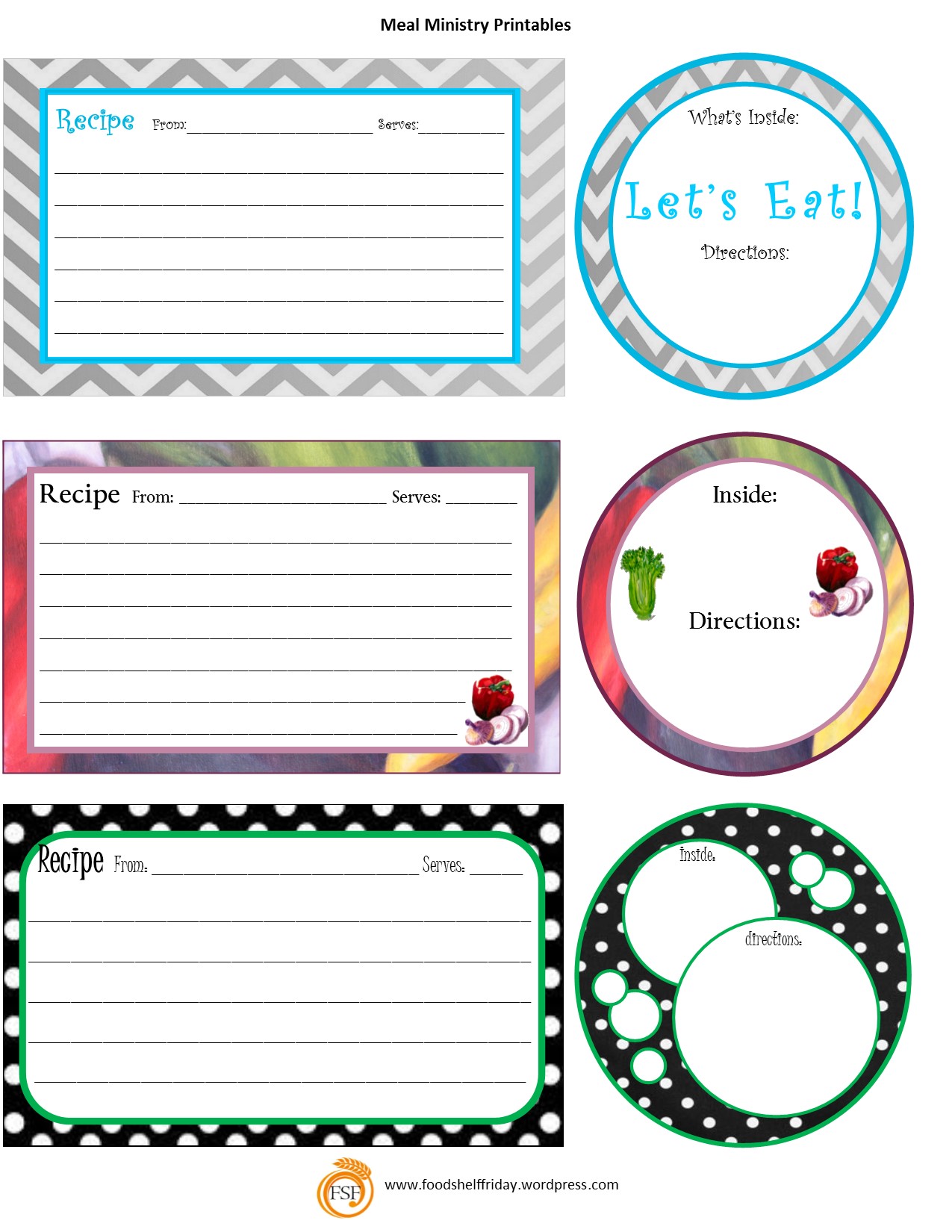
At the bottom of this post is a free printable – some cute Meal Ministry labels and matching recipe cards. Feel free to print and share (they’ll work best on medium weight white cardstock).  I pinned a bunch of blog posts and recipes about Meal Ministry to the Food Shelf Friday Pinterest account.  Click HERE for those links, including more printable labels.

Above all an attitude of service and sensitivity are the keys to successfully blessing others with meal ministry. Now go out there and be a blessing! Remember if you have other ideas to add to this topic, or a great meal ministry recipe, share it in the comments!

printables for meal ministryprintables for meal ministry

Thoughts from a Visit to the Playground of the Rich & Famous

chalk

Over Christmas, my family was fortunate to cross something off our “bucket list” by spending part of winter break in Aspen and Snowmass, Colorado. My husband and son are downhill skiers, so for years we have been dreaming of the winter when J would be old enough and experienced enough to enjoy a couple days on a real mountain. At 14, and with 5 years’ experience on the modest ski hills of Minnesota, we decided he was ready, so we packed up the SUV and hit the road! (That sounds so spur of the moment. We actually planned and prepared for MONTHS researching housing options, routes, ski packages, etc.)

Aspen is whole different world. I didn’t recognize any celebrities, but there are paparazzi shots online that prove quite a few celebs were in town when we were. Pretty much every store in Aspen is designer. Pretty much every restaurant is fine dining. I saw more furs on the streets than you see in the cages at a zoo. Set all that against the glorious backdrop of snow draped mountains, and it was simply unreal to this small town girl who grew up on the plains of North Dakota.

The cost of living in Aspen is much higher than it is here in the Minneapolis suburbs. We tried to save money by doing some of our meals in the villa we stayed in. It helped, but their grocery prices were so high that it didn’t make as big of a difference as I expected. I saw a sign at one real estate office that said the lowest priced single family home on the market in Aspen was over $2 million! And very few of the owners of those multi-million dollar homes actually live in them. They are vacation properties owned by high rollers who can afford to keep a place just for winter ski vacations. Ooh la la. And I felt really spoiled just to drive out and spend a couple days there. The idea of owning there – especially just for vacations – blew my mind!

Of course, this made me wonder how regular people make it. We encountered a number of bus drivers, waiters, resort staff, etc. during our trip. While they make good money in tips and overtime during Christmas, the crowds thin at the end of the ski season, and the other three-quarters of the year are much slimmer pickings. In conversations I discovered that most of them don’t live in Aspen, but commute in from surrounding towns like Carbondale and Glenwood Springs.  As we passed through those communities on the highway, I saw neighborhoods full of old trailer homes and some grubby looking apartments. For the young who love to ski and want to spend a season or a couple years in the beauty of the mountains, that works out. But for families, living off service jobs in seasonal resort community with a high cost of living is very difficult. According to the local paper (the slogan on the masthead gave me a chuckle: “If you don’t want it printed, don’t let it happen”), 77% of kids in the Aspen school district receive free or reduced-price lunches.  This indicates a significant poverty level among the permanent residents.

I don’t really have some big conclusion from all this, just a new eyewitness awareness of the poverty that it takes to support the posh life. As much as we enjoyed the stunning scenery, the guys enjoyed the skiing, and we all enjoyed the hospitality, I was happy to go home. I like my simple home, my comfy bed, and the self-reliance of my everyday life. I’m even excited to eat our FSF meal of Tuna Helper and canned corn tonight. Perhaps that’s the real takeaway. Just like it takes a certain level of poverty to support the fancy life of wealth and fame, so it also takes a certain level of restraint, simplicity, and self-denial in our comfortable lives to support everyone. As Mother Theresa said, “Live simply so others can simply live.”

10885474_10204766410373511_4127405263603778524_n
Spectacular mountain view from one of the ski hills.