One of the best books I’ve read about hunger and poverty is Ronald J. Sider’s Rich Christians in an Age of Hunger. Sider takes apart the myriad roots of poverty and hunger and analyzes the solutions that various individuals, charities, and government programs employ to try and combat poverty and hunger. Sider’s top method for poverty alleviation is microfinance loans. But what is microfinance?
It’s kind of like the old saying – give a man a fish and he eats for a day; teach a man to fish and he eats for a lifetime. Charitable handouts, welfare programs, and emergency relief measures fill gaps to help people get back on their feet when they have that opportunity. For example, if a family’s chief breadwinner loses his or her job, welfare programs might help the family make ends meet until a new job is secured. If a natural disaster wipes out a family’s possessions, emergency relief programs meet their needs until the crisis is over. But for situations of chronic poverty and hunger, a short-term solution just won’t cut it.
The key to battling chronic poverty is to create jobs and economic opportunities. This is the idea behind microfinance loans. Developing world citizens who need small loans cannot get them from banks. They usually don’t have any collateral, and there may not even be banks near them. So microfinance organizations connect prospective borrowers and donors. This allows average people to invest in the lives of others, and borrowers use the little loans to do things like start or expand businesses, or buy livestock. As the borrowers succeed, they repay the loans (which have really low if any interest). It’s not a handout, it’s an opportunity for long-term success. With the loan repaid, the donor or the organization can make another loan.
I haven’t personally invested in microfinance, but I’m curious about it and have done some digging online. Charity Navigator rates microfinance organizations, so with just a little research you can find a reputable place to donate. Once you select your organization, you pick your loan recipient. You can find projects with an environmental component, look for female-owned businesses, or pick a project in a part of the world you’re drawn to. Most of the projects I saw in my brief look around were about $1000, and they broke that up to involve donors of modest amounts, like $25.
I love the idea of making an investment in an individual. It’s kind of like an adult version of sponsoring a child through Compassion International. You can pray for your people and their business, and you get to see updates of how your little investment is paying dividends in the life of an individual or family.
Stopgap programs serve an important function, but for long-term community change, the jobs and economic opportunities created by access to capital can feed a person or family for a lifetime.
Have you ever made a microfinance loan? What organization did you donate through? What was your experience like? Share in the comments!
Do you remember those terrible commercials where Sally Struthers would come on the screen and cry about children in need of sponsors? Nothing makes me change the channel faster than a well-paid celebrity guilting me into donating. Don’t get me wrong, I know the need is real, and it breaks my heart. And I love the idea of sponsorship – the letters, the pictures, making an investment that impacts one life instead of being spread thin across an organization. But I’ve always wondered if those things were legitimate or if everyone gets the same little form letter and picture.
I don’t know which organization Sally Struthers was crying for, but I know legitimate sponsorship exists – it’s called Compassion International. I first learned about Compassion when Christian rock band Audio Adrenaline talked about it at concerts back in the 90s. Then my parents, sister, and a couple friends started sponsoring kids, and they all had great things to say about it. So about eighteen months ago, when my church held a Compassion sponsorship drive, I sent my son to the table to pick out a child.
His name is Edouard. He’s six, and he lives in a farming community in Burkina Faso. He likes to play soccer, and he has the most beautiful brown eyes. Every month, Compassion International charges me about $40, and they use that money to provide Edouard with education, including school fees and uniforms, health care, and an introduction to Jesus. He doesn’t write yet, but his teachers at the Compassion center read our letters to him and help him write to us. We’ve gotten pictures of him several times, and it’s fun to see him grow. He has drawn us pictures and asked questions about our lives (he was rather concerned last winter when his teachers told him about how cold it gets in Minnesota). We got a letter from his pastor once, and recently we got a picture of him with his parents. I am confident that he is a real child who really benefits from my sponsorship.
Charity Navigator backs me up on this. Compassion International is a four-star rated organization. Their income has been expanding each year, and their output has followed suit. 84% of money donated to Compassion goes to programming, and the other 16% goes to advertising and administration costs. That’s pretty good. The CEO makes under $200,000/year, which in the world of CEOs is pretty much minimum wage…
One of my favorite things about Compassion is that they organize missions trips every year, and if you go along to your child’s country, they will arrange for you to meet them and their families, and to see their Compassion center. They will also help you arrange a meeting if you visit your child’s country on your own.
I would love to meet Edouard someday, and who knows, maybe I will. But even if we don’t meet on this side of heaven I will enjoy exchanging letters and pictures with him and watching him grow up healthy and educated because of our little gift and the work of Compassion International.
If you’re interested in sponsoring a child or supporting the work of Compassion, visit their website at www.compassion.com.
Do you have a Compassion child? Tell us about him or her in the comments!
I find that my sympathy leans toward children more easily than adults. Sometimes an adult’s struggle is the result of poor decisions, but children generally don’t deserve the challenges they face. On top of that, it seems that kids have more of an opportunity to break the cycles of poverty and succeed in life, which makes an investment in kids that much more rewarding. One way I like to help kids is school supplies. I LOVE school- and art supplies. Yes, you’ve heard my story, you know how I longed and lusted for that big box of crayons with the sharpener in the back. My parents were practical and practically broke through much of my childhood, so we didn’t get shiny new supplies every fall just because. We got the cheapest possible version of things we needed when we needed them.
As a parent, I see the ways in which I internalized these memories. I am happiest in a paperie (stationary store) or even an office supplies store. I own hundreds of well-loved colored pencils, scrapbooking markers, drawing pencils, etc. (I even have a Facebook page for the little pictures I doodle). I loved taking my son shopping for back-to-school (he’s going to high school this year (!!!) so the plain notebooks and pens aren’t as much fun to buy), and I always bought him quality art supplies. But I never bought him that big box of crayons. I make him use backpacks, shoes, jackets, and clothes until they don’t fit or are too beat up. I find myself pulled between the half of me that wants him to have everything I ever wanted as a child, and the half of me that appreciates my parents’ practical frugality. I don’t think it’s healthy for a kid to be handed everything he ever wanted; it spoils them. I want J to appreciate things, but at the same time I don’t want him to suffer for lack.
Many kids go back to school embarrassed by their lack. They get some cheap crayons and pencils during the great back-to-school sales, and they smuggle them into the classroom in a brown paper bag. Teachers are pretty good about making sure their students get what they need by pooling supplies for the whole class to share, or even spending some of their limited income to fill in gaps. But you don’t have to be a teacher to help with this need. Here’s a simple plan for a school supplies drive you can do at your office, church, or community group.
Make clear decisions so everyone is on the same page. Pick a specific school that the supplies will go to, make a list of what’s needed, and have a specific, central drop off location.
Find out what the real needs are. Once you’ve decided on a school to work with, call the office and ask what their biggest needs are. When our MOMS Club chapter did a school supplies drive we learned that backpacks are hard for low income families to get, as they cost a lot more than pencils and erasers. Kids without a backpack are more likely to lose permission slips and other important information that needs to get home and back.
Share the information with your group of people. Make a flyer or email that clearly states where the supplies are going, what the biggest needs are, and where people can drop things off.
Think outside the (pencil) box. Back to school means more than just art supplies and notebooks. Back to school means tennis shoes, clothes, and for those of us in the frozen northland, time to start thinking about fall jackets and winter gear. Ask the school about their non-craft supply needs as well. You might be surprised what you learn. In working with a local elementary school, our church learned that underwear is a real need for the schools. Younger kids have accidents, and school nurses like to have something on hand to get kids back to class with minimal learning time disruption or embarrassment. We had some fun with that one and held and “Undie Sunday” where people were encouraged to bring new packages of underwear and diapers that were distributed through the school and The Diaper Drive. The unusual theme of that drive made people laugh, and they remembered to pitch in!
Consider accepting cash donations as well. In your information about the event, let your participants know that you will also accept cash donations and exactly what that cash will go for. You might say something like, “cash donations will be pooled together to provide more backpacks,” or you could even give the cash right to the school and let them put it to work wherever it’s needed most (maybe field trip fees, recorders for music class, etc. The possible expenses are endless – all the parents say “AMEN!”)
Follow through. Drop off the supplies in a timely manner and be transparent about how much cash came in and where it went. Make another flyer or email that cheers donors and lets them know the results of their generosity.
Kids deserve an equal opportunity to learn and grow; thank you for making it possible!
Are you a teacher? Have you hosted a school supplies drive? Do you have any additional suggestions? Leave a comment!
I read a story in one of Jen Hatmaker’s books about a school in Africa visited every summer by a group of American teens on a short-term mission trip. Every year the local leaders sent kids to muddy the walls of their school in preparation for the Americans coming in. The building didn’t need painting, but they needed the Americans’ support, so they had to give the missions team something to do to feel useful. Clearly the Americans thought they were helping, but the local people didn’t have the heart (or possibly the power) to tell them they were wasting time and ridiculous amounts of money. Having been on a short term missions trip and part of outreaches, it made me wonder how often I have reinvented a perfectly good wheel and gotten in the way of what really needed to be done.
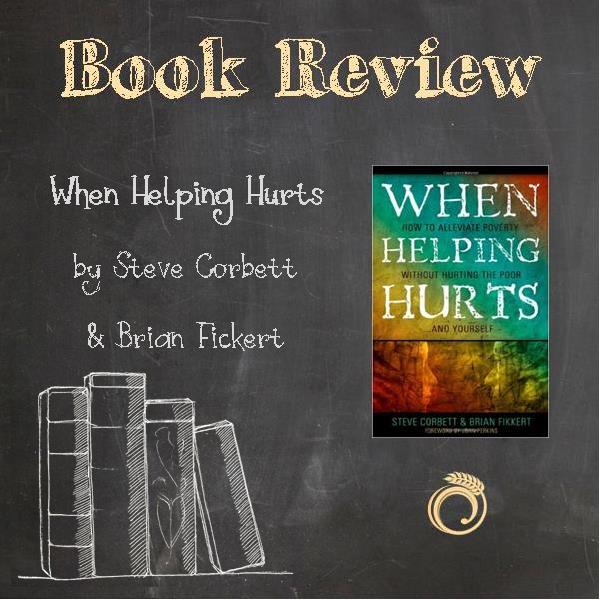
A few years ago I heard about the book When Helping Hurts: How to Alleviate Poverty Without Hurting the Poor and Yourself by Steve Corbett and Brian Fikkert. I’ll admit it paralyzed me. Until I read the book, just knowing that it was out there made me afraid I would find out that the mission trip and outreach programs I had participated in were full of mistakes that had done more harm than good. As we prepared for the Convoy of Hope event, I decided that it was time to read the book. Maybe it would give me some guidance as we planned the outreach.
I didn’t love it. There are some good points, for sure. But I feel that it lacks focus. Some parts are for average people who want to help, and some parts are like a policy manual for people starting a non-profit or establishing benevolence policy for a church. Not being a pastor or policy maker, I became frustrated with the advice about things I can’t control, and bored with the technical financial jargon. There are a ton of acronyms and technical financial concepts (not my particular skill set). I feel it should have been two books – one for minimizing the mistakes of average people involved in charitable work, and one more technical manual for pastors and policy makers.
Least you think I hated the book, let me share with you some of the good parts:
“Our relationship to the materially poor should be one in which we recognize that both of us are broken and that both of us need the blessing of reconciliation. Our perspective should be less about how we are going to fix the materially poor and more about how we can walk together, asking God to fix both of us.” (p.79)
There is a necessary emphasis on helping the poor in a way that empowers them and restores dignity. The authors encourage people to start their charitable programs by taking an inventory of what a community has to work with, rather than what it lacks. “…the very nature of the question – What gifts do you have? – affirms people’s dignity and contributes to the process of overcoming their poverty of being. And as they tell us of their gifts and abilities, we can start to see them as God does, helping us to overcome our superiority, that is, our own poverty of being.” (p. 126)
“Pouring in outside resources is not sustainable and only exacerbates the feelings of helplessness and inferiority that limit low-income people from being better stewards of their God-given talents and resources.” (p. 126)
“The money spent on a single STM (short term missions) team for a one- to two-week experience would be sufficient to support more than a dozen far more effective indigenous workers for an entire year.” (p. 173)
So you see, there are valuable practical insights throughout the book, but I’m afraid they’re lost on the less business-minded. I found it hard to keep reading when the authors spent several chapters on banking details and interest rates, as that’s not likely something I’ll ever make decisions about.
The other problem I have with this book is the way the authors encourage us to judge people in need to determine not just what type of aid will be most beneficial, but whether we should help at all or let people learn from consequences. In my experience, most people are more than happy to blame the poor for their plight and use that excuse to not help. A Christian engaging in relief work should look first and foremost to the Bible for direction, and the Bible tells us “judge not.” On the other hand, if you’re a policy maker for a church or non-profit, there are judgments you have to make to efficiently and responsibly manage your organization. Separating this into two books would have made this clear and allowed the authors to go into greater detail for the different audiences.
So I give this book a mixed review. On one hand it has many thought-provoking insights, and on the other hand, it spends too much time on technical financial issues and encourages judgment over mercy. If you’re in a position to be making benevolence policies for your church or non-profit, it’s worth a read. If you’re just an average volunteer who wants to avoid making blunders, don’t let the knowledge that this book exists stop you from getting involved. A little compassion and respect is what you really need to make sure your help doesn’t actually hurt.
The big weekend is finally here! Naturally the last minute stuff for the Convoy of Hope Minneapolis rally is taking up a lot of my time, so my blog post today is based on the devotional I have been putting together for the Children’s Shoes volunteer team. If your mission this week is Convoy, serving at your church, or any other means of blessing others, let this word encourage your work!
John 13:3-17 (at the last supper) Jesus knew that the Father had put all things under his power, and that he had come from God and was returning to God; so he got up from the meal, took off his outer clothing, and wrapped a towel around his waist. After that, he poured water into a basin and began to wash his disciples’ feet, drying them with the towel that was wrapped around him. He came to Simon Peter, who said to him, “Lord, are you going to wash my feet?” Jesus replied, “You do not realize now what I am doing, but later you will understand.” “No,” said Peter, “you shall never wash my feet.” Jesus answered, “Unless I wash you, you have no part with me.” “Then, Lord,” Simon Peter replied, “not just my feet but my hands and my head as well!” Jesus answered, “Those who have had a bath need only to wash their feet; their whole body is clean. And you are clean, though not every one of you.” For he knew who was going to betray him, and that was why he said not every one was clean. When he had finished washing their feet, he put on his clothes and returned to his place. “Do you understand what I have done for you?” he asked them. “You call me ‘Teacher’ and ‘Lord,’ and rightly so, for that is what I am. Now that I, your Lord and Teacher, have washed your feet, you also should wash one another’s feet. I have set you an example that you should do as I have done for you. Very truly I tell you, no servant is greater than his master, nor is a messenger greater than the one who sent him. Now that you know these things, you will be blessed if you do them.
Right away verse 3 just jumps off the page to me. Jesus KNEW his place in the kingdom. He knew who he was in God’s eyes and had eternity in mind. When we know our worth we don’t have to go around proving it by seeking status. When we keep eternity in mind we’re less interested in the earthly version of position.
Have you ever had a really good boss? He or she probably supported you, encouraged you, and made sure you had the tools to succeed. Bad leaders are all about their own ego and reputation. The best leaders are servant leaders like Jesus. It’s not about being on top, it’s about making sure everyone has the support and resources they need to succeed.
Jesus knew who he was, he knew it was all about eternity, and he led by taking care of others so the message could be magnified.
Matthew 6: 31-46 “When the Son of Man comes in his glory, and all the angels with him, he will sit on his glorious throne. All the nations will be gathered before him, and he will separate the people one from another as a shepherd separates the sheep from the goats. He will put the sheep on his right and the goats on his left. “Then the King will say to those on his right, ‘Come, you who are blessed by my Father; take your inheritance, the kingdom prepared for you since the creation of the world. For I was hungry and you gave me something to eat, I was thirsty and you gave me something to drink, I was a stranger and you invited me in, I needed clothes and you clothed me, I was sick and you looked after me, I was in prison and you came to visit me.’ “Then the righteous will answer him, ‘Lord, when did we see you hungry and feed you, or thirsty and give you something to drink? When did we see you a stranger and invite you in, or needing clothes and clothe you? When did we see you sick or in prison and go to visit you?’ “The King will reply, ‘Truly I tell you, whatever you did for one of the least of these brothers and sisters of mine, you did for me.’ “Then he will say to those on his left, ‘Depart from me, you who are cursed, into the eternal fire prepared for the devil and his angels. For I was hungry and you gave me nothing to eat, I was thirsty and you gave me nothing to drink, I was a stranger and you did not invite me in, I needed clothes and you did not clothe me, I was sick and in prison and you did not look after me.’ “They also will answer, ‘Lord, when did we see you hungry or thirsty or a stranger or needing clothes or sick or in prison, and did not help you?’ “He will reply, ‘Truly I tell you, whatever you did not do for one of the least of these, you did not do for me.’ “Then they will go away to eternal punishment, but the righteous to eternal life.”
I have long been bothered by this word “least.” It sounds like a statement of value, and Americans don’t like that idea. We like “all men are created equal,” not greatest/least. So who are the “least of these”? I don’t think Jesus was referring to value when he said “least.” The Bible affirms the value of people over and over. The psalmist says that God knit you together in your mother’s womb and journaled out the days of your life. Jeremiah reminds us that He has good plans for us. Romans 8:28 says that all things work together for the good of those who love God. I think what Jesus means by “least” is those with the least power or least access to resources, like widows, orphans, and those with physical or mental limitations. The people we minister to through our volunteer work are valuable, hardworking people, many of whom (and for a variety of reasons) have less power and less access to resources. Our role is NOT to judge whether or not they are truly in need or if they are to blame for their own situations. Our only role is to be the hands and feet of Jesus – the same Jesus who forgave prostitutes, healed lepers, and forgave tax collectors.
We volunteer so the hungry, jobless, shoeless, etc. can get back on a more level playing field where we can run the race of life side by side.
We can’t “fix” the poor and hungry. We are broken, flawed people, not gods. But we can recognize that there is need in this world and that we have the means (money, time, etc.) to partner with these people who are just trying to take care of their families. I hope that you to see the people you serve as your equals in value who may be the “least of these” in terms of their power and/or access to resources.
So laugh with a child. Bless a mom who is working hard to get her kids ready for school. Make an immigrant family feel welcome in their new home. Wash some feet. And remember what it says in Colossians 3:23, “Whatever you do, work at it with all your heart, as working for the Lord.
Two Convoy of Hope trucks have arrived at Spring Lake Park High School for Saturday’s Minneapolis rally




 foodshelffriday.com