Category Archives: Service Projects

Hope is Coming: Convoy of Hope Minneapolis

Hope is Coming

I’m running a little behind this week. My husband is on vacation, so while my days are filled with the usual work, we’ve also been working on home improvement projects like refinishing the deck, and entertainment like movies and baseball games. It’s exhausting. As much as I have loved having S around more, I just wish we could have been on vacation at the same time.

One of the things that has been keeping me on my toes is the upcoming Convoy of Hope rally here in the Twin Cities. I’m serving on the organizing team as the lead for children’s shoes. Donations have been rolling in, the planning and red tape are going well, and it’s going to be a great event. So for today’s post I thought I would tell you all about Convoy of Hope as an organization and the upcoming rally here in Minneapolis-St. Paul.

Convoy is a faith-based non-profit organization that provides disaster and poverty relief around the world. They are probably best known for the truckloads of supplies they deliver after natural disasters. They also have feeding programs in eleven countries, and dozens of domestic rallies every year that provide immediate physical relief to people in poverty.

Convoy of Hope has an excellent reputation, with a four-star rating from Charity Navigator. They scored 100% in transparency and accountability. They have developed partnerships with churches around the world as well as major corporate partners.

The Twin Cities rally is coming up on Saturday, August 1, at Spring Lake Park High School. Gates open at 10:00 am. Every adult (up to 10,000 people) will receive a ticket that they can redeem for a free bag of groceries as they leave, and a free lunch will be served to everyone. During the event there will be tents where different local organizations will be providing health screenings, pregnancy tests and ultrasounds, job services, and community services. We’re giving away shoes (provided by Toms) for women and children. We’ll be taking family pictures. There is a DJ coming, and a whole kids’ zone filled with games and inflatables. The entire event is free.

Convoy, the local organizing team, and the volunteers who are giving their day to this event hope that the rally brings an infusion of hope and alleviates some of the immediate physical needs of people in our community.

-If you are in need, all you need to do is show up. No one will ask you to apply or qualify for the event. If you have needs, come have them met. Free of charge, and free of judgment. You are our guest of honor.

-If you can spare a few hours to help out that day, we NEED you! My tent, children’s shoes, needs 125 volunteers to organize the inventory, measure little feet, and run shoes to their new owners. Volunteers will be given a free t-shirt and lunch. All volunteers need to be ten or older. Volunteers between 10 and 13 need to be working alongside a parent or guardian. Volunteers between 14 and 18 will need a waiver signed by their parent or guardian. Volunteers over 18 can sign their own waivers J There is a volunteer rally on Friday night at Emmanuel Christian Center (7777 University Ave in Spring Lake Park) where the volunteers will get their shirts and all the details about logistics. If you want to volunteer, all you have to do is come to the rally on Friday and sign up. If you want to be guaranteed that you will be working in the cool tent (kids’ shoes!), let me know and I can get you signed up for my team.

If you don’t live in the Twin Cities area, you can still help out! We need prayer warriors to join us in begging God for good weather. There is no backup rain date, the show goes on as long as the weather isn’t actually unsafe. Pray also that people who need this boost would hear about the event and be able to attend. And if you can’t be here but you want to physically contribute, the kids’ shoes tent needs a few more supplies for the event. Contact me by July 15 and I’ll get you a link to the supplies we need. Convoy is a 501(c)3 non-profit organization, so if you do make a financial contribution to the event, it’s tax-deductible.

I am really excited to be a part of this rally. When I was a kid my family went through some lean times. I didn’t get new shoes for back to school. I was lucky if I got them when my old shoes wore out! I remember when I was in 5th or 6th grade, the sole separated from my shoe. As I walked down the hall it went flap. flap. flap. My mom tried several times to repair it with rubber cement, but it just kept flapping. I made light of it; that’s just what I did. But inside, I was embarrassed. I believed that I wasn’t as cool (and dare I say even as valuable) as the other kids because my clothes were off-brand and hand-me-down, my shoes were in terrible shape, and I never got the fancy new school supplies other kids had. I cannot tell you how I coveted the big box of Crayola crayons with the sharpener in the back. God and my parents saw to it that I had my needs met – we never went hungry – but I know how it feels to feel like less. I’m excited to put new shoes on hundreds of kids before they go back to school this fall!

A few links for you:
Convoy’s site about the Minneapolis event, including a video about volunteering.
The Facebook Event page for the Minneapolis rally
Charity Navigator‘s review of Convoy of Hope

Edited to add:
It occurred to me during my thinking time/commute that I should tell you the rest of the story about my flapping shoe. I was in 5th grade at the time, and my little sisters were 7 and 4. We had been living in a small town for about a year, where my dad was the pastor at his very first church. The church wasn’t doing super well financially, so we weren’t either. On top of that dad had his brand new bible college (read: private university tuition) student loans to pay for. Our needs were met, but that was pretty much it.

So I was in 5th grade, wearing a cheap pair of shoes that I was undoubtedly hard on. I was one of those active, forgetful kids who was hard on things. I remember being surprised that the sole of my shoe was letting go so soon after we bought them. I knew my mom would be upset, but I also remember picking at it, because 11 year olds are neither wise nor terribly smart… So as I mentioned above, the sole of my shoe was hanging on by a thread, and everywhere I went it made a slapping flapping sound. I played it off as a joke. I made it flap loudly on purpose. It’s a shell game, a defense mechanism that kids use. If I make my embarrassing thing a joke, then you won’t judge me about it. In theory.

But it was basketball season, which made it that much harder. I was terrible at basketball. Really, really, terrible. But I played in 5, 6, and 7th grade because that’s just what we did. I rode in the bus and sat on the bench and practiced, but that was about it. And I did that in my messed up shoe. I’m not sure why I didn’t give up basketball; the clues were all there that this was not for me, and I didn’t harbor any delusions of becoming good at it. But I had to be strong and funny and as much like everyone else as I could be.

A couple weeks into the season, my mom showed up at practice. This was the 80s, maybe 1990 at the latest. Moms did not come to sports practice. They were at home dust bustering or something. The coach whistled and waved me over to mom, who had a shoe box in her hands and an eager look on her face. “Here,” she said, “this just came in the mail.” I lifted the lid to find a pair of white high top LA Gear tennis shoes with peach and pastel green trim. To this day I don’t know if my parents ordered them from the Sears catalog or if one of my grandmas sent them, but they were my first pair of real, kind-of name brand shoes (LA Gear was cool for a short time and then faded into pop culture history with Girbaud jeans and big hair). I clearly remember how I felt – the surge of self-esteem and joy at the newly leveled playing field. Am I dramatizing? A bit; it’s hard to make words that describe that fleeting lift. The shoes didn’t make me good at basketball (they weren’t magic). But they gave me a boost up from “mockable” to “normal.”

As an adult I regret that it mattered that much to me. I know that my true worth is not based on brands or fads, and I abused, wore out, and outgrew the new shoes too. I’m sorry that my goal in life was to blend in and be normal. But for kids, especially those in the tween/teen phase, “normal” and blending in really matter. Perhaps you’ll be happy to know that my son doesn’t get new shoes for back to school just because it’s fall. He gets them when he wears out or outgrows his current pair. I did get him new crayons every fall during elementary school, but it was the typical 24 pack, not the mega box with the sharpener. As Mary Poppins said, “Enough is as good as a feast,” and perhaps because I remember, I am satisfied to provide J with “enough.”

Open Homes: Foster Care and Adoption “Part four: What can we do?”

Open Homes 4

During the month of June, I’ve been exploring the issues of foster care and adoption in a series I call Open Homes: Foster Care and Adoption. If you haven’t read the other posts, here are the links:

Week one: What is the Need? – Statistics about foster care in America and orphans around the world.

Week two: Meet the Panel – An introduction to the panel of foster and adoptive parents who helped with the series and a few recurring themes of their experiences.

Week three: The Hunger Connection – Food-related issues prevalent in foster and adoption situations.

-Week four: What Can We Do?

There is a story going around the internet about a psychology professor. Discussing perseverance, the professor held up a glass of water. Everyone expected to hear the old “half full or half empty” debate. But the professor surprised them by asking instead, “How heavy is this glass of water?” Students offered their guesses. Eight ounces, ten ounces, etc. The professor then told them that the actual weight of the glass was not nearly as important as the duration of the hold. Anyone can pick up a glass of water for a few seconds; it feels virtually weightless. But after a few minutes, the glass begins to feel heavy. After a few hours it gets painful. Holding it up all day will leave you shaky and sore.

In Exodus 17, Moses experienced that. God inspired him to climb a hill overlooking a battlefield and hold up his staff. As long as he did, the Israelites were defeating the Amalekites in battle. When his hands fell, the Amalekites gained on the Israelites. This seems like an odd thing God asked of him, and my initial response is to wonder why. What did the Israelites gain from Moses standing there with his staff in the air? Maybe God was testing Moses’ obedience, or the exhaustion helped him empathize with the men who fought all day. Maybe seeing Moses on the hill with his staff in the air was inspiring for the soldiers. Maybe this story was put there for us.

Like the professor’s glass of water, Moses’ staff got heavy. His arms began to tremble. He faced a test of willpower. Did he want victory more than comfort? As long as he chose victory he had it, but comfort came with defeat. That’s deep stuff that is also true for us today. In so many areas of our lives we can choose comfort, but it comes with a terrible price. But that’s a lesson for another day. Today I want to consider what happened when Moses was at the end of his physical ability. Just when Moses thought he couldn’t hold up his arms any more, when his elbows and shoulders were giving out, Aaron and Hur arrived and held Moses’ arms. His arms were still raised, but the pain was gone and his will was strengthened; he knew it was possible to win because he didn’t have to be strong enough to do it alone.

Like Moses, foster and adoptive families face a daunting task. Even in the best of circumstances, the kids coming into their homes have faced loss and scarcity. And supporting these kids day and night is exhausting. But we can be Aaron and Hur for families around us.

1 – Pray – the transitions, the challenges, the joys, all of it needs to be covered in prayer. Prayer works, and the first thing it does is keep your heart soft and your eyes open to the needs around you. Pray for families you know who are adopting or who take in foster kids.

2 – Offer practical help – We all know that “let me know if I can help,” however sincere, doesn’t get much of a response. It’s hard to admit when you need help. Good friends don’t wait to be asked. Like Aaron and Hur they show up and pitch in. Panel member Gena said, “Reach out — help — even when it looks like a family “has it all together,” they are probably struggling in some ways.” Panel members suggested offering help around the house or babysitting.

3 – Treat the kids as kids – The stories of foster and adoptive kids really pull at your heartstrings. But they’re not the only ones facing challenges, and kids are very sensitive to inequality. Several panel members pointed out that elevating the foster or adopted child above the other kids in the family causes rifts between the kids and even encourages some negative behaviors. Treat foster and adopted kids just like anyone else their age; give them a chance to be normal.

4 – Sympathize (or empathize) – Parents of all stripes need to vent now and then. And kids of all stripes are both wonderful and challenging. Check in with your friends who foster or are in transition with an adoption. Remind them that you are praying for them, and offer (and re-offer) to pitch in. Even if they don’t take you up on it, they will know that you are thinking of them and that you are aware of the challenges they’re facing. If Moses had refused Aaron and Hur’s attempt to hold up his arms, I imagine they would have stayed nearby in solidarity and continued to offer their help until he accepted.

5 – Material support – Some of the families in the panel have had sudden placements. Foster kids often arrive with nothing but a paper grocery bag of dirty clothes. Taking in a kid who comes with nothing is expensive and daunting. A surprise Target gift card lifts burdens and spirits. Ask what the kids need. I’ve seen friends give luggage, school supplies, bedding, clothing (new and gently used), baby equipment, groceries/meals, toys/games, and even salon services to bless kids and their foster families. If a friend is adopting, throw a “big kid baby shower” or participate in adoption fundraisers. International adoption in particular is very expensive and it’s a huge blessing when friends donate or host fundraisers. There are tons of great fundraiser ideas online.

I hope you have learned some things this month about foster care and adoption. As always I encourage you to pray for the children without a forever family and the people who care for them. And if you have more ideas about being Aaron and Hur for foster and adoptive families, leave a comment!

Service Project – Blessing/Homeless Bags

Blessing Bags

Let’s see if this is familiar: You’re driving down the highway, observing the speed limit (close enough…), never tailgating (I obviously think highly of my readers), and listening to some great music. You see your exit approaching, slow down, and merge into the exit lane. As you glide down the ramp, you see him. Standing there at the intersection by the highway overpass. He’s ragged looking. Unshaven. Needs a haircut and some clean laundry. He’s holding a sign that says, “Will Work for Food” or “Homeless Veteran – Anything Helps.” Instantly your mind races. Thoughts whip back and forth from judgment to compassion and back in under a second. You know they want money, but you don’t know what they’ll do with it, and you don’t want to enable someone’s drug or alcohol problem. Maybe your mind flashes to the scene in Trading Places where the police catch Eddie Murphy’s character conning people by begging for donations while pretending to be a disabled veteran. Coming face to face with someone begging is a helpless, conflicted feeling. I have often wished there was something helpful I could offer them.

I think I have a solution. Like most solutions these days, I found it on Pinterest. They’re called “blessing bags” or “homeless bags.” Basically it’s a large Ziploc bag filled with toiletries and healthy snacks that you keep in your car and hand out in those situations when you want to do something. Some months after I saw this on Pinterest, I was talking to my friend, Cathy, about it, and she told me about her experience doing this just last year. So I used Cathy’s insights and experience as well as the Pinterest ideas to put together three of these bags.

First of all, J was totally not into it. “Mom, why are we doing this?” “Mom, are you going to make us go out looking for homeless people to give them to?” “Can I go play video games now?” It sounds like my son is totally self-absorbed. He’s fourteen, so that’s pretty much accurate, although he has his moments… But Cathy had warned me that creating the bags hadn’t kept her much younger son’s attention either. “(My son) did help me put them together, and I told him they were for people who don’t have homes. He didn’t really seem interested or try to make sense of it until he went with (his dad) to hand them out. I supposed their reaction was a memorable experience for him.” This led to a series of good discussions with her son about homelessness, and he was only three at the time! It’s never too early to make kids aware of the needs of others.

What to put in the bags: First of all, remember that you are going to be keeping these bags in your car, so avoid things that will melt or freeze. Be mindful of the nutritional value of snacks, as well. If a person has gone without food for a while, they don’t need junk, they need real nutrients. So here are some of the items I put in my bag, ideas from Cathy, and suggestions from Pinterest:

  • Shampoo
  • Soap
  • Razor
  • Washcloth
  • Lotion
  • Sunscreen (I had skin cancer, so this was top of my list!)
  • Toothbrush
  • Toothpaste
  • Deodorant
  • Kleenex
  • Comb
  • Mirror
  • Hand sanitizer
  • Antibacterial wipes
  • Pre-packaged healthy snacks like granola or granola bars, crackers, dry fruit/raisins, trail mix, nuts, jerkey, mints, etc.
  • Gift card to Subway or another healthy and alcohol-free restaurant
  • List of local resources, shelters, food banks, etc.
  • A small book or bible

I always snag the little travel sized products when I’m staying in hotels, so I had a stash from which I picked my shampoo, soap, and lotion. I also had some travel size toothpaste and unopened toothbrushes from the dentist, and an assortment of prepackaged snacks. So I gathered all of that together and divided out three of each item I wanted to include in my bags. Then at lunch last week I grabbed some $5 Subway cards along with my sandwich. Currently my bags each contain a travel soap, a travel bottle of shampoo, a travel lotion, a $5 gift card to Subway, and some healthy snacks. I should point out that I put the toiletries into a smaller zipper bag inside the big one, because I didn’t want the scents form the hygiene products to affect the flavor of the snacks.
20150512_195735

Still on my shopping list are antibacterial wipes, one more mini sunscreen (I had two), three washcloths, purse packs of Kleenex, 3 gender neutral deodorants (or one woman’s deodorant as I have two men’s travel deodorants in my stash).

Altogether, I think it will cost me about $30 out of pocket to put together these three bags, and the Subway cards are the single biggest expense. The cost will vary depending on what unopened stuff you already have on hand and what you choose to include.

Thoughts on delivery: The idea behind these blessing bags is that you would open your car window and hand them out to homeless people begging at intersections. In theory, that is. Cathy found that sometimes she would be in the wrong lane, or the light would change and it made it hard to pass them out that way. She tried pitching the bag out her window, but felt that was undignified and came with the risk of the bag being mistaken for trash or not getting to its intended target. After that she took to parking her car and walking to hand deliver the bags.

However you make your deliveries, be safe. While many homeless people are just down on their luck, others are mentally ill or addicts. Don’t put yourself or your kids in a dangerous situation by going out in the dark. Choose well-lit public places. If you’re worried that you can’t safely deliver the bags yourself, take them to a shelter where they can be handed out by the staff.

Comments? Questions? Additional suggestions? – Leave a comment!

Meals on Wheels 101 and Service Opportunity

Meals on Wheels

In 2010 there were 57 million senior citizens (defined as over the age of 65) in America. That number is expected to double to 112 million seniors in 2050. This explosive growth is because 10,000 baby boomers turn 65 every day, and American life expectancy is at an all-time high. Seniors are the fastest growing population segment in America.

As seniors age, many struggle to remain independent. Expenses grow faster than their fixed retirement income and Social Security cost of living increases can keep up. Physical problems make it hard to get around. Social isolation, especially in rural areas, may mean that no one checks on their health and safety for weeks at a time. Senior citizens have to fall back on Medicare/Medicaid more heavily when their physical and/or social limitations lead to longer hospital stays after treatments, or earlier nursing home moves.

The solution is really quite simple. Someone needs to check on seniors who live alone, and help them get groceries and prepare a hot meal. Of course in most situations the family takes care of these needs, but what about seniors who have no family, or those who live far from their loved ones?

That is the idea behind Meals on Wheels (MOW). Meals on Wheels is a 501(c)3 non-profit organization that has provided hot meals and check-ins to seniors who are poor, physically disabled, or socially isolated since their first meal delivery in Philadelphia back in 1954. They claim to save tax money by allowing seniors to be safely independent for a longer time.

Funding for MOW is a public-private partnership. There is some tax money designated to feed seniors in need, but much of their income comes from corporate and private donations of money and food, and most of their work is done by volunteers. Meals on Wheels America is the national organization. They oversee more than 5,000 community-based MOW operations around the country. Nationwide, those local chapters deliver more than a million meals a day, and more than 2 million volunteers work with them preparing food, delivering meals, serving (MOW dinners are served at some senior centers as well as home delivery), doing office work, helping at events, and conducting safety checks.

The time commitment for volunteers and the skills needed vary from job to job. To find out what kind of help is needed in your area, or to put yourself or a loved one on the list to receive Meals on Wheels, contact your local MOW chapter (Find it HERE).

Sources:
Meals on Wheels has faced some budget cuts in recent years. This CNN Article from 2013 was helpful in my research and covers the topic of their funding issues.

The Better Business Bureau has rated the national MOW organization. See that review HERE.
Charity Navigator has reviewed the local MOW chapters. Visit their site to search for your local chapter.

The national Meals on Wheels website has tons of great resources for seniors and their families.

Have you or a loved one experienced Meals on Wheels? Share your story in the comments!

Service Project: Birthday Bags

Birthday Bags

A million years ago (give or take a few… It’s been a jam-packed week and my stay-at-home mom days feel REALLY far away), my son and I were part of a terrific group called MOMS Club. We had playgroups, field trips, park days, holiday parties, fundraisers, and service projects. Finding this group was a godsend for me and for J. Now, in middle school, he is still close friends with some of the MOMS Club kids.

I loved our service projects. We sponsored a room at a local women’s shelter, providing it with bedding, window coverings, and an occasional fresh coat of paint. We collected school supplies for a different school in our community each fall. We adopted a family in need during the holidays. One mom was a leader of her daughters’ scout troop, and she headed up a service project she had learned about from the troop’s work with the food shelf.

The staff at our local food shelf explained the heart rending situation that they see all the time; families barely scraping by cannot afford to do anything special for their kids’ birthdays. As a parent, this broke my heart. Can you imagine staring at the calendar hoping you’ll have enough just to feed your kid on his birthday and wishing desperately that you had a way to make the day special? There is something we can do. A glimmer of hope and caring in a seriously sad situation. Birthday Bags – gift bags filled with the basic items that make up a birthday celebration.

We had a lot of fun with this project. We bought plain, solid colored gift bags at the dollar store and let our kids decorate them with crayons and stickers. They were very festive! We designated some to be for boys, some for girls, and some gender neutral. Not having any little girls in my life (I now have nieces – I didn’t then), I ate up the chance to pick out princess plates and pink napkins. We delivered about a dozen of these bags to the local food bank, and they gave us a tour of their facility. That was eye opening for us and our kids. A lot of the tidbits you see on this blog are things I learned on that tour!

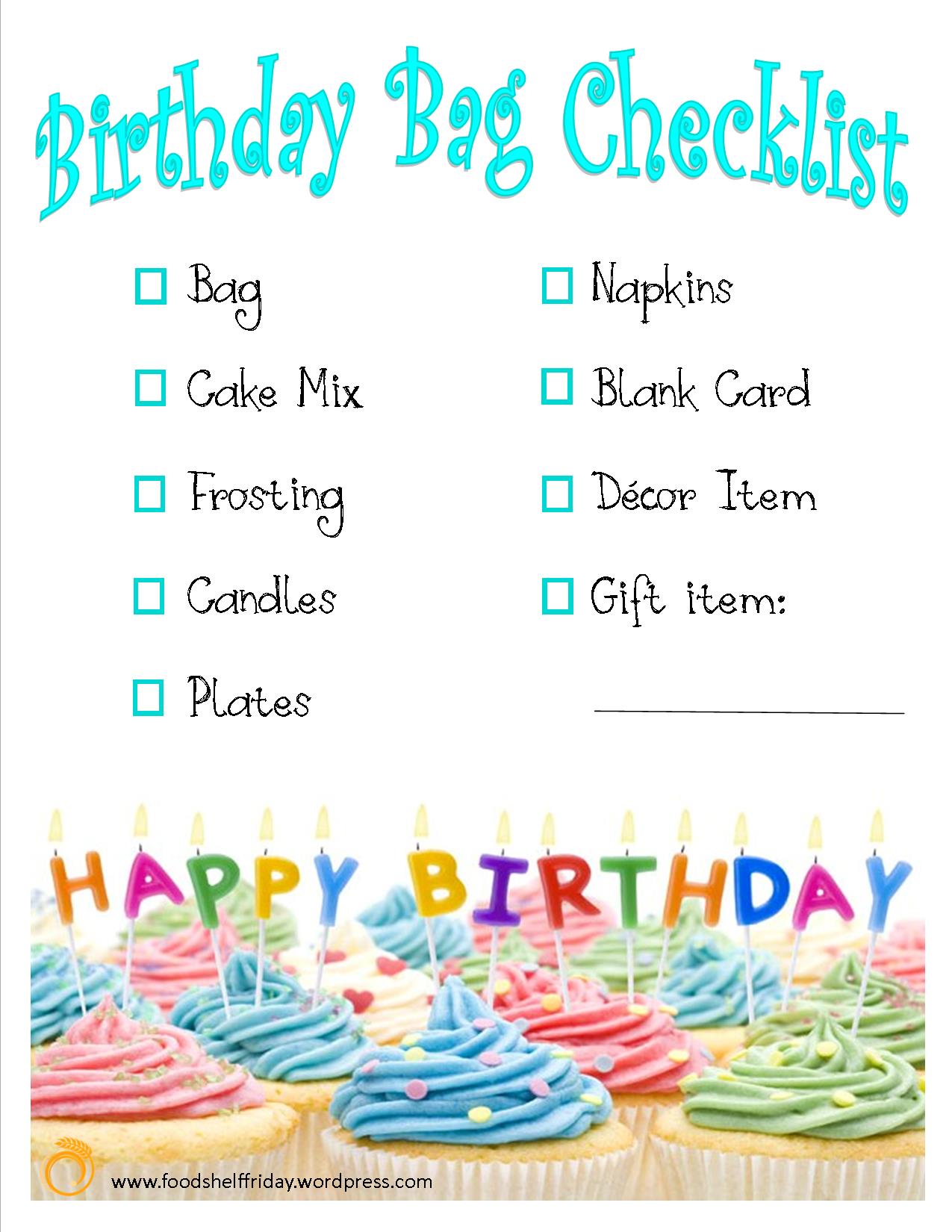
So here’s the list of what to put into a Birthday Bag. I made a printable checklist, too. Feel free to print, post, and share the printable (.jpg and .pdf on the bottom of the page):

  1. A bag: Buy birthday themed gift bags at the dollar store, use paper grocery bags, or do what we did and get the kids participating in the project by decorating solid colored paper bags.
  2. A cake mix: If you watch the sales, you can usually get cake mixes for $1.00-$1.50 each.
  3. Frosting: Get frostings that go with the cakes you bought, and remember that certain flavors are more kid-friendly than others. German chocolate, for example, is delicious with all the coconut and nuts, but it’s not really a kid flavor. We stuck with the basics, chocolate cake with chocolate frosting and white cake with white or confetti frosting.
  4. Candles: Dollar Tree to the rescue! When we last did this project, the dollar store was selling boxes of birthday candles at three boxes for $1.00. That’s 33 cents a box, and they were all varieties of rainbow colors.
  5. Paper plates and napkins: Back to the dollar store! It really made this project affordable for us. They have a ton of cute birthday plates and decorations that will only set you back $1.00 per item, and they have some really fun designs.
  6. A décor item (optional): A package of streamers that match the plates, a “Happy Birthday” banner, or some other fun décor item makes it feel like a celebration. Have fun with this, and choose something to make the day special! One word of caution: Latex balloons are probably not a great idea. Lots of people are sensitive/allergic to latex, and they pose a choking hazard for young kids and pets. If you send balloons, include that info on the note attached to the bag so it goes to a family that can use them.
  7. A blank birthday card: Hallmark has a line of basic cards that start at 99 cents. Sometimes the drug store chains or grocery stores offer a coupon for an additional amount off the purchase of a couple cards. Last time I used that deal I got three 99 cent cards and they gave me a dollar off, so three cards for $2.00. The dollar store might have some good deals, too. Don’t write on the card; just include the blank card and its envelope in the birthday bag. Mom and Dad can write on it and they can have credit for throwing the birthday celebration. The kids don’t need to know that their parents had help from the food bank and its donors to make this happen. If you want to include your well wishes, the bag is a good place for a quick, anonymous note like, “Happy Birthday! Hope you have an awesome day!”
  8. A gift item: This is the point where you really decide how much you want to spend on this project. Some groups send along a $5-10 gift card to a mass retailer like Target or Wal-Mart. Some send books. Others send along a toy or two from the dollar store. This is really up to the budget you set for the project. We did dollar store party favors in our bags – another celebration item instead of a gift. Next time I think I’ll send books or coloring books and crayons, and some gift cards for older kids.

Clip a note to the outside of your bag that indicates if the package is for a boy, girl, or either, as well as what age its best suited for. Include the info about balloons if you’re including them, and what the gift item is. Make it simple for the food shelf staff and volunteers to grab a birthday bag that will be most useful and meaningful for the family. I made a printable for this as well (link on the bottom of the page); they print four to a page. When you’re ready to deliver your bags, call ahead (or take them along with your next food donation drop off). You want to stop by to make your drop off when it’s most convenient for the food shelf staff and volunteers.

Birthday bags are a popular service project for families and groups, so there are a TON of ideas and tips on Pinterest. Click HERE to go to Food Shelf Friday’s Pinterest page where I have a board for birthday bag ideas as well as a bunch of inspiration, links to FSF blog posts, and ideas for additional service projects. If you have other ideas or tips from your experience building Birthday Bags, add them in the comments.

Birthday Bag Checklist

Birthday Bag Checklist (link to .pdf – the image above is .jpg)

Brithday Bag Attachment Printable