
Blessed to be a Blessing

blessed to be a blessing

Food Shelf…Saturday?

I’ve been sidelined by illness this week (my husband went to Europe for work and brought me a terrible head cold as a souvenir. He got well relatively quickly, I’m still fighting…)

Anyway, I haven’t forgotten you. I actually sat down and wrote a book review post on Tuesday, but I want to polish that up a bit before I share it. Then on Thursday I had an experience with the Lord that I would like to share with you.

I was laying on the couch, watching a movie – a typical sick day activity, and as the credits rolled I was just overwhelmed by all the excess of this world. I felt sickened by all the stuff and all the resources, all the entitlement and all the waste. I just sat there feeling down about my perspective and the war within my flesh. I know that under normal circumstances I would have gotten off the couch and done something “productive” to satiate this overwhelming feeling that I am spoiled. I would have sorted through some things to donate, mended something to make it last, or just about anything to busy my hands and feel less like a slug who watched Die Hard on Thursday afternoon on a beautiful summer day. But this cold. I didn’t have the energy.

Then I heard a familiar voice in my head, “what does the Bible say?” (Yes, God talks to me now and then in my head. He doesn’t reveal the future or anything like that, but he sends me the gentlest reminders, right when I need them.) I grabbed a piece of scratch paper and a pen, and I started to put down what God says about my relationship with this world:

This world is not my home. Is that a scripture or a song lyric, Lord? A sad amount of my theology/biblical knowledge is actually song lyrics that sometimes aren’t even from the Bible. I’d better google that one. 1 Peter 2:11-12: Dear friends, I urge you, as foreigners and exiles, to abstain from sinful desires, which wage war against your soul. Live such good lives among the pagans that, though they accuse you of doing wrong, they may see your good deeds and glorify God on the day he visits us. Foreigners and exiles: This world is not my home

If this world is not my home, I am not going to fit in or be comfortable here: I know where to find this one: Romans 12:2: Do not conform to the pattern of this world, but be transformed by the renewing of your mind. Then you will be able to test and approve what God’s will is—his good, pleasing and perfect will.

This kind of reminds me of Daniel and the exiles in Babylonian captivity. The food of their new world made them sick. A steady diet of what the world has to offer makes me sick. Daniel 1:8-17: But Daniel resolved not to defile himself with the royal food and wine, and he asked the chief official for permission not to defile himself this way. Now God had caused the official to show favor and compassion to Daniel, but the official told Daniel, “I am afraid of my lord the king, who has assigned your food and drink. Why should he see you looking worse than the other young men your age? The king would then have my head because of you.”
Daniel then said to the guard whom the chief official had appointed over Daniel, Hananiah, Mishael and Azariah, “Please test your servants for ten days: Give us nothing but vegetables to eat and water to drink. Then compare our appearance with that of the young men who eat the royal food, and treat your servants in accordance with what you see.” So he agreed to this and tested them for ten days.
At the end of the ten days they looked healthier and better nourished than any of the young men who ate the royal food. So the guard took away their choice food and the wine they were to drink and gave them vegetables instead.
To these four young men God gave knowledge and understanding of all kinds of literature and learning. And Daniel could understand visions and dreams of all kinds.
I like the “choice food” of this kingdom. I like comfort. I like stuff, especially nice stuff. But it makes me spiritually sick.

This life isn’t about my comfort; I will get no rest here. John 16:33: In this world you will have trouble. But take heart! I have overcome the world.

I have too much stuff. I feel like I say this a lot. It may be my personal motto. Too. Much. Stuff. Matthew 6: 19-21: Do not store up for yourselves treasures on earth, where moths and vermin destroy, and where thieves break in and steal. But store up for yourselves treasures in heaven, where moths and vermin do not destroy, and where thieves do not break in and steal. For where your treasure is, there your heart will be also.

I am NOT the hero of my own story. Ephesians 2:8-9: For it is by grace you have been saved, through faith—and this is not from yourselves, it is the gift of God— not by works, so that no one can boast.

We are fully made for heaven while fully living in this world. There will always be a war in each of us between the citizen of heaven’s priorities and the citizen of earth’s priorities. Matthew 16:41: The spirit is willing, but the flesh is weak. Keep up the good fight, everyone, we not blessed to be comfortable, we are blessed to be a blessing!

thoughts on blessing and this world


Talking to Your Kids About Hunger (and other difficult subjects)

Talking to your kids about hungerOne of the great challenges of parenthood is talking to your kids about tough topics like hunger and training them to be critical thinkers and generous adults. Hunger isn’t fair, and it isn’t easy to understand or explain why we have so much when others have so little. Even as adults and parents, we don’t have all the answers. So how do we talk about tough topics like hunger with our kids? The short answer is that it varies – but there are some things we can do to navigate these muddy waters.

  1. Find Balance: (I feel so lame telling you to find balance. It’s like telling you to get more sleep or reduce your stress) Find the right balance between acknowledging the tough issues and controlling your kids’ exposure to troubles. A key here is that if they are old enough to notice and ask questions, they deserve honest answers. At three, a kid isn’t going to understand hunger at all, because they don’t really see past what they want at this exact moment. But we teach toddlers to share, and that’s an age-appropriate start. Preschoolers are more sensitive to what’s going on around them, and they start to see differences between people and ask questions about it. At this point, we can talk about how we are all different, but all loved by God, and all worthy of kindness.

    There is no hard and fast rule that applies to every kid, at every age. Some kids are really sensitive, and they need productive but limited exposure to the world’s bad parts or it eats them up. Other kids are less sensitive, and they sometimes need that exposure to crack through their shells. You know your kids. You know how tough topics affect them. You have to decide how much exposure they can handle.

    Likewise, find balance in your sources. The news media loves to sensationalize the bad parts, and fill the screen with graphic pictures that scare us into tuning in. Other organizations focus on the hope, but many use guilt tactics to raise money. Make sure you’re keeping an eye on what your kids see, and actively balance the messages they’re getting. Ask questions like, “why do you think the ASPCA makes commercials with pictures of sad dogs and cats?” By discussing what they see, you diffuse the guilt-inducing power of advertising and sensational news media. You also open the door to positive conversations.


  1. Turn a Tough Topic into an Opportunity for Conversation: Once a tough conversation starts, our instinct is often to provide trite answers and end it as fast as possible. We’re afraid we’ll say the wrong thing or upset our sensitive kids. And to be quite frank, we’re uncomfortable with the unfairness of hunger, and many of us struggle with guilt over how much we have and how others suffer. But I urge you, don’t shut down a wondering child. That sends the message that they shouldn’t care, and I know that’s not the message you want to send.

    Instead, turn the conversation into an opportunity. Talk about how things aren’t fair and we should be thankful for everything we have. Talk about what the Bible says about poverty and hunger, and what the Bible tells us to do. Deuteronomy 6:6-9 says, “These commandments that I give you today are to be on your hearts. Impress them on your children. Talk about them when you sit at home and when you walk along the road, when you lie down and when you get up. Tie them as symbols on your hands and bind them on your foreheads. Write them on the doorframes of your houses and on your gates.” Take ANY and EVERY opportunity to talk to your kids about God and his commands!

  2. Look for Heroes and Ways to Help: Beloved TV host Mr. Rogers once said, “When I was a boy and I would see scary things in the news, my mother would say to me, ‘Look for the helpers. You will always find people who are helping.’” This is a great reminder to us adults when we watch the news, and good parenting advice as well. Remind your kids (and yourself) to look for the people who are standing up for justice. Look for the heroes who rush in when everyone is rushing out. Look for the aid workers who dedicate their lives to being in hard places for the sake of others. Look for volunteers and donors who make recovery possible.

    And then ask the most important question of all – “how can we help?” Finding a way to get involved diffuses feelings of powerlessness, victimization, and selfishness. Helping teaches compassion and generosity, and instills in us all a sense of community. Serving others is obedience to God’s commands. It opens doors for new friendships and opportunities to tell others about Jesus.

    If you’re not sure where to start, here are a few ideas:
    – In the search bar at the top of this page, key in “service projects” and all the posts I’ve done on that topic will appear.
    – Food Shelf Friday’s Pinterest page has two boards of service project ideas, and one of them is specifically geared toward serving with kids.
    – Sponsor a child through Compassion International, or write to your sponsored child.
    – Go through your toys and clothes, and donate a box of clean, usable items to your local Salvation Army, Goodwill, or local food shelf (If they take that type of donation).
    – Pick up a few extra items when you’re shopping, and donate them to a food shelf or a supply drive at your church.

There are a ton of ways you and your family can help others; this barely scratches the surface! Feel free to share ideas in the comments!

Family Service Project: Food Shelf Scavenger Hunt

Food Shelf Scavenger HuntMy favorite co-server in life is my son, J (his real name is Jacob, but I call him J because he doesn’t like “Jake.” Yes, I am so lazy that I reduced his name to one letter). He’s fifteen years old, and is smart, funny, and a good worker. Though much of his service experience has come during his years as a Boy Scout, he really got his start in our local MOMS Club chapter when he was just a preschooler. We started ‘em young in that group; the kids participated in a lot of tours, supply drives, and service projects. An amazing thing happens when you bring your young kids to service opportunities; they never have to learn to serve. It just comes naturally because it has always been their reality.

20160721_200624
Yesterday, J and I volunteered with Compassion International finding sponsors for kids

But serving alongside a fifteen-year-old is a lot easier than working with a preschooler was! When the kids are young, they need simpler tasks, patient parents, and a lot of information on WHY we’re doing what we’re doing. With that in mind, I have created a Food Drive Scavenger Hunt that you can use to teach your kids, grandkids, or nieces and nephews about helping the hungry. It’s in a printable form right on this page, and I invite you to print and share as much as you like.

The printable lists five of the top needed food shelf staples, gives information about why they matter nutritionally, and educates on specifics to look for, like low sodium and whole-grains. I believe the whole scavenger hunt can be done for under $10 (depending on the choices you allow). Several kids can work together, or each kid can do his or her own list – that’s up to you and your budget. The scavenger hunt could work for kids as young as three if you do the reading, but would be informative and entertaining for kids as old as 12. It teaches best practices while still allowing kids to make choices. You can use the scavenger hunt to distract and entertain the kids during your regular grocery shopping, or you can make a special trip that ends with drop off at the food shelf.

I strongly encourage you to find ways that your young kids can serve their community. I know it can be a challenge for parents, but it’s a lot easier to introduce service when they’re young and want to help than it is when they’re older and would rather watch TV!

What ways have you found to include your children in community service? Share in the comments, and keep an eye out for more family-friendly service opportunities in the future!

Kids food drive scavenger hunt


Kids food drive scavenger hunt


Preview image is a .jpeg; follow the hyperlink above for the .pdf version to print. Feel free to share!

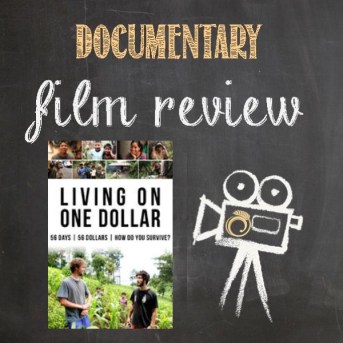
Documentary Film Review: Living on One Dollar

Living on $1

Tonight I watched a documentary called Living on One Dollar. (Available to watch free on YouTube) The film was a student project featuring four American college students who spend 8 weeks in a poor rural village in Guatemala. During their eight week stay, the guys live on $1 per person per day while growing a crop of radishes. They use only what they had or could buy, and they divide up their summer’s worth of money in a random fashion to simulate the unpredictable finances of the poor, many of whom are day laborers, working when they can and suffering when they can’t.

On the downside, the film’s production values are far from perfect, especially in regards to sound. The film is just one hour long, and there are areas that could have been greatly expanded to make it feature-length. But keep in mind that it’s a student project, and as such it is actually very well done. My only small problem with the project itself is that the guys did not seem very prepared; they lacked knowledge about the agricultural practices they wanted to try. I know that in the developing world you can’t just google how to do something (although cell phones and internet are becoming more and more prevalent around the world), but the locals would have had information and experience that was passed down to them from their parents and a lifetime of experience in the local environment and economy. These Americans did not have that, and they could have used the internet to better simulate that familiarity.

But those are small details. Over all I thought the film was very well done. These guys really got their hands dirty and experienced life in rural Guatemala in a fairly realistic way. They scrimp and ration, go hungry, and come to appreciate the small things, like having enough to include bananas in their diet. They learn some valuable tricks from friendly locals, like how to increase their caloric intake by adding lard to their rice and beans. They attempt to take out a loan from a traditional bank and fail, using that as an opportunity to talk about the role of community support and microfinance through Grameen Bank.

About two or three weeks into their stay, a local boy invites them to come and visit his school. Here we see the guys absolutely light up as they talk, laugh, and play with the local kids. But back at their house in the village, it leads to a hard discussion about why some of the kids don’t go to school. One local boy who befriends them is Chino, a 12-year-old whose family cannot afford to send him to school and whose labor is needed to support his family. In many parts of the world, children are only educated if their family can afford the required school fees, supplies, and sometimes uniforms. Families often have to choose which of their kids to educate, if they can afford to send any. This lack of educational opportunity stunts economic development in families, communities, and nations.

I risk giving away too much, so I’ll stop here. But do see this movie. It’s only an hour long, it’s free to watch on YouTube, and it’s a great story of more than poverty and problems; it’s about people, community, and opportunity.

Have you seen Living on One Dollar? Share your thoughts in the comments!