What Does the Bible Say About Poverty and Hunger?

What does the Bible say.pub

March is Bible month, so I’m jumping on that bandwagon and taking a look at what the Bible says about poverty and hunger.

Like most comfortable middle-class Americans, I squirm when faced with the reality of a poor and starving world. I’ll admit that I sometimes play dumb and ignore my responsibilities to my fellow man. It’s really easy to feel that I have no time or money to give, or that helping others might put me in danger (picking up hitchhikers is something I will probably never do, sorry Jesus). We have made ignoring what the Bible teaches about poverty into an art form. We pick and choose, brushing aside the directives and attacking the poor with verses that condemn laziness and drunkenness. If we can pass the blame for poverty, our guilt is appeased and we can go back to enjoying our favorite TV show.

It is not God’s plan for you to be guilty and miserable. He isn’t glorified by your guilt.

The simple truth is that there is a big, hungry world out there. Innocent children and hardworking adults suffer as the result of corrupt systems, natural disasters, and physical and mental disabilities as well as bad decisions. It is time for us to put down the remote and take an honest, open-eyed look at what the Bible teaches about poverty and hunger.

As Christians, we are no longer subject to the law God commanded on the Israelites. Jesus paid that debt, fulfilled that covenant, and created a new contract with humanity. But the law still has much to tell us about the God who authored it.

*Leviticus 19:9-10: When you reap the harvest of your land, you shall not wholly reap the corners of your field, nor shall you gather the gleanings of your harvest. And you shall not glean your vineyard, nor shall you gather every grape of your vineyard: you shall leave them for the poor and the stranger: I am the Lord your God.
*Deuteronomy 15:11: For the poor will never cease from the land; therefore I command you, saying, ‘You shall open your hand wide to your brother, to your poor and your needy, in your land.’

God’s covenant with the Israelites commanded them to leave enough margin in their lives that they could provide for the poor. Do we have enough margin in our lives, or are we strapped so tight that we just feel powerless and guilty?

The Psalms and Proverbs overflow with references to God’s feelings for the poor.

Psalm 41:1: Blessed is he who considers the poor; The Lord will deliver him in time of trouble.

Psalm 72:4: He will bring justice to the poor of the people; He will save the children of the needy, And will break in pieces the oppressor.

Psalm 82:3-4: Defend the poor and fatherless; Do justice to the afflicted and needy. Deliver the poor and needy; Free them from the hand of the wicked.

Psalm 140:12: I know that the Lord will maintain The cause of the afflicted, And justice for the poor.

Proverbs 14:31: He who oppresses the poor reproaches his Maker, but he who honors Him has mercy on the needy.

Proverbs 19:17: He who has pity on the poor lends to the Lord, And He will pay back what he has given.

Proverbs 21:13: Whoever shuts his ears to the cry of the poor Will also cry himself and not be heard.

Proverbs 22:9: He who has a generous eye will be blessed, for he gives his bread to the poor.

Proverbs 29:7: The righteous considers the cause of the poor, But the wicked does not understand such knowledge.

Proverbs 31:20 (The virtuous woman): She extends her hand to the poor, Yes, she reaches out her hands to the needy.

And that’s just a sampling of the many verses David and Solomon wrote about God’s concern for the poor and our role in meeting the needs of others.

Proverbs also contains a number of verses condemning laziness.

Proverbs 10:4: He who has a slack hand becomes poor, But the hand of the diligent makes rich.

Proverbs 19:15: …An idle person will suffer hunger.

Proverbs 24:33-34: A little sleep, a little slumber, A little folding of the hands to rest; So shall your poverty come like a prowler, And your need like an armed man.

The same author, King Solomon, tells us to give to the poor and that laziness causes poverty. I don’t believe his opinion on poverty changed from day to day, nor do I think Solomon had any idea of blaming the poor for their condition. I think the reason for including both commands is because they are both aimed at the reader, not the reader’s perception of others. Think of it as a parent imparting wisdom to a child. We strive to raise generous kids, and we also want them to be hard working. Solomon wasn’t giving his readers a means to judge others, he was instructing them on how they themselves should live – both generous and hard working.

A few other favorites:

Isaiah 61:1-3 (Prophesy in Isaiah, read and fulfilled by Jesus in Luke 4:18-22): The spirit of the Lord God is upon Me, Because the Lord has anointed me To preach good tidings to the poor; He has sent me to heal the brokenhearted, To proclaim liberty to the captives, And the opening of the prison to those who are bound: To proclaim the acceptable year of the Lord, And the day of vengeance of our God; To comfort all who mourn, To console those who mourn in Zion, To give them beauty for ashes, The oil of joy for mourning, The garment of praise for the spirit of heaviness; That they may be called trees of righteousness, The planting of the Lord, that He may be glorified.
If this is a (rather poetic) summary of Jesus’ ministry here on Earth, it is abundantly clear that Jesus didn’t come to bring us prosperity, but comfort, peace, freedom, and hope. Our end goal is to be like Jesus and bring glory to God, so we need to do the same – bring comfort, peace, freedom and hope to those in bad situations.

Micah 6:8: He has shown you, O man, what is good; And what does the Lord require of you But to do justly, To love mercy, And to walk humbly with your God?
Mercy AND justice. Victims want justice without mercy, and the guilty want mercy without justice. But God doesn’t see it as an either-or situation like we do. He commands us to be fair to others and offer mercy, even to those who are not fair to us. It sounds hard, that’s why we have to walk humbly with our God. Sometimes poverty is caused by injustice that we should fight, but sometimes people need mercy to help them step away from their past mistakes.

Matthew 25:31-46: (from verse 40) Assuredly, I say to you, inasmuch as you did it to one of the least of these My brethren, you did it to Me.
We may be comfortable here in modern America, but as the story in this passage shows, one day we will stand before Jesus and He will want to know why we ignored Him when our fellow man was hungry, naked, or in prison. And judging by the end of the passage, “we didn’t know it was you” isn’t going to be the right answer.

Luke 14:13-14: But when you give a feast, invite the poor, the maimed, the lame, the blind. And you will be blessed, because they cannot repay you; for you shall be repaid at the resurrection of the just.

Acts 20:35: …it is more blessed to give than to receive.

1 Corinthians 13:1-3: Though I speak in the tongues of men and of angels, but have not love, I have become sounding brass or a clanging cymbal. And though I have the gift of prophecy, and understand all mysteries and all knowledge, and though I have all faith, so that could remove mountains, but have not love, I am nothing. And though I bestow all my goods to feed the poor, and though I give my body to be burned, but have not love, it profits me nothing.

We are instructed over and over to care for the poor, but as the 1 Corinthians verses show, it’s not about the actions, it’s about the attitude. Care for the poor and hungry shouldn’t come from fear of a smiting God, but from genuine love. Seeing the world the way God does, and stepping up to be His representatives to the precious people who are poor and hungry.

John 13:35: By this all will know that you are My disciples, if you have love for one another.

Obviously, the main source for this post was the Bible. All verses quoted are from the New King James version, and the odd random looking capitalization is included just the way it looked in my Bible app. I also gathered information from Ronald J. Sider’s book Rich Christians in an Age of Hunger: Moving from Affluence to Generosity. Feel free to add your thoughts or favorite verses in the comments!

Service Project: Birthday Bags

Birthday Bags

A million years ago (give or take a few… It’s been a jam-packed week and my stay-at-home mom days feel REALLY far away), my son and I were part of a terrific group called MOMS Club. We had playgroups, field trips, park days, holiday parties, fundraisers, and service projects. Finding this group was a godsend for me and for J. Now, in middle school, he is still close friends with some of the MOMS Club kids.

I loved our service projects. We sponsored a room at a local women’s shelter, providing it with bedding, window coverings, and an occasional fresh coat of paint. We collected school supplies for a different school in our community each fall. We adopted a family in need during the holidays. One mom was a leader of her daughters’ scout troop, and she headed up a service project she had learned about from the troop’s work with the food shelf.

The staff at our local food shelf explained the heart rending situation that they see all the time; families barely scraping by cannot afford to do anything special for their kids’ birthdays. As a parent, this broke my heart. Can you imagine staring at the calendar hoping you’ll have enough just to feed your kid on his birthday and wishing desperately that you had a way to make the day special? There is something we can do. A glimmer of hope and caring in a seriously sad situation. Birthday Bags – gift bags filled with the basic items that make up a birthday celebration.

We had a lot of fun with this project. We bought plain, solid colored gift bags at the dollar store and let our kids decorate them with crayons and stickers. They were very festive! We designated some to be for boys, some for girls, and some gender neutral. Not having any little girls in my life (I now have nieces – I didn’t then), I ate up the chance to pick out princess plates and pink napkins. We delivered about a dozen of these bags to the local food bank, and they gave us a tour of their facility. That was eye opening for us and our kids. A lot of the tidbits you see on this blog are things I learned on that tour!

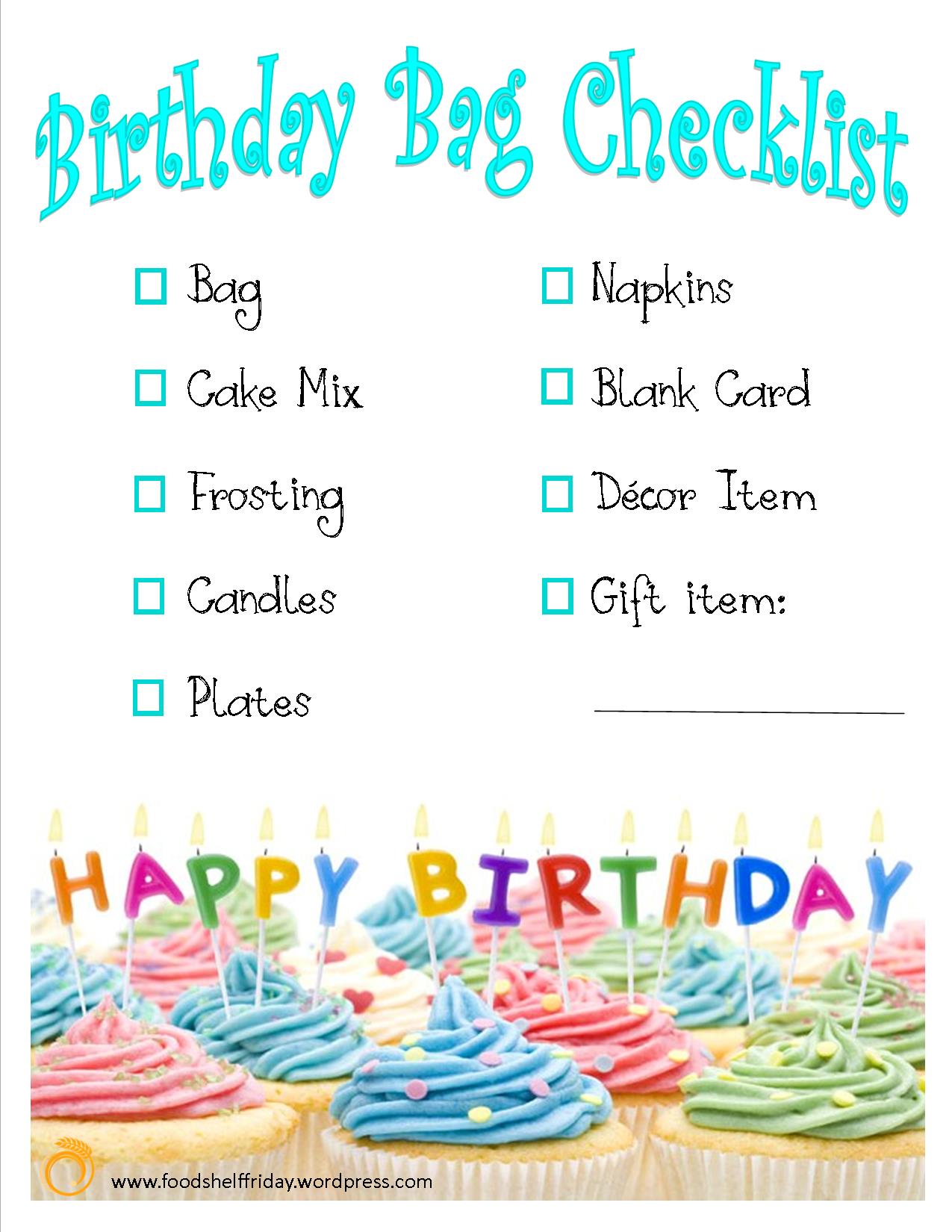
So here’s the list of what to put into a Birthday Bag. I made a printable checklist, too. Feel free to print, post, and share the printable (.jpg and .pdf on the bottom of the page):

  1. A bag: Buy birthday themed gift bags at the dollar store, use paper grocery bags, or do what we did and get the kids participating in the project by decorating solid colored paper bags.
  2. A cake mix: If you watch the sales, you can usually get cake mixes for $1.00-$1.50 each.
  3. Frosting: Get frostings that go with the cakes you bought, and remember that certain flavors are more kid-friendly than others. German chocolate, for example, is delicious with all the coconut and nuts, but it’s not really a kid flavor. We stuck with the basics, chocolate cake with chocolate frosting and white cake with white or confetti frosting.
  4. Candles: Dollar Tree to the rescue! When we last did this project, the dollar store was selling boxes of birthday candles at three boxes for $1.00. That’s 33 cents a box, and they were all varieties of rainbow colors.
  5. Paper plates and napkins: Back to the dollar store! It really made this project affordable for us. They have a ton of cute birthday plates and decorations that will only set you back $1.00 per item, and they have some really fun designs.
  6. A décor item (optional): A package of streamers that match the plates, a “Happy Birthday” banner, or some other fun décor item makes it feel like a celebration. Have fun with this, and choose something to make the day special! One word of caution: Latex balloons are probably not a great idea. Lots of people are sensitive/allergic to latex, and they pose a choking hazard for young kids and pets. If you send balloons, include that info on the note attached to the bag so it goes to a family that can use them.
  7. A blank birthday card: Hallmark has a line of basic cards that start at 99 cents. Sometimes the drug store chains or grocery stores offer a coupon for an additional amount off the purchase of a couple cards. Last time I used that deal I got three 99 cent cards and they gave me a dollar off, so three cards for $2.00. The dollar store might have some good deals, too. Don’t write on the card; just include the blank card and its envelope in the birthday bag. Mom and Dad can write on it and they can have credit for throwing the birthday celebration. The kids don’t need to know that their parents had help from the food bank and its donors to make this happen. If you want to include your well wishes, the bag is a good place for a quick, anonymous note like, “Happy Birthday! Hope you have an awesome day!”
  8. A gift item: This is the point where you really decide how much you want to spend on this project. Some groups send along a $5-10 gift card to a mass retailer like Target or Wal-Mart. Some send books. Others send along a toy or two from the dollar store. This is really up to the budget you set for the project. We did dollar store party favors in our bags – another celebration item instead of a gift. Next time I think I’ll send books or coloring books and crayons, and some gift cards for older kids.

Clip a note to the outside of your bag that indicates if the package is for a boy, girl, or either, as well as what age its best suited for. Include the info about balloons if you’re including them, and what the gift item is. Make it simple for the food shelf staff and volunteers to grab a birthday bag that will be most useful and meaningful for the family. I made a printable for this as well (link on the bottom of the page); they print four to a page. When you’re ready to deliver your bags, call ahead (or take them along with your next food donation drop off). You want to stop by to make your drop off when it’s most convenient for the food shelf staff and volunteers.

Birthday bags are a popular service project for families and groups, so there are a TON of ideas and tips on Pinterest. Click HERE to go to Food Shelf Friday’s Pinterest page where I have a board for birthday bag ideas as well as a bunch of inspiration, links to FSF blog posts, and ideas for additional service projects. If you have other ideas or tips from your experience building Birthday Bags, add them in the comments.

Birthday Bag Checklist

Birthday Bag Checklist (link to .pdf – the image above is .jpg)

Brithday Bag Attachment Printable

National School Lunch Program 101

Lunch Program 101

Whether you and your kids attend(ed) public school, private school, or homeschool, I think we can all agree that it is a comfort to know a free basic education is the right of every child in America. Public schools in America offer more than just reading, writing, and arithmetic. Counseling services, career guidance, and physical exercise are also offered up free of charge. Additionally, during the school day the kids are fed lunch. Like choosing private or homeschool instead of public, parents can choose to pack a lunch for their kids instead of taking the hot meal. And like the public school option, it is comforting to know that a free basic lunch is available to those who cannot otherwise afford to eat.

The United States federal government instituted the National School Lunch Program (NSLP) in 1946. The USDA website does a nice job describing what they do, so I’m not going to reinvent the wheel. Here is what they said:

Generally, public or nonprofit private schools of high school grade or under and public or nonprofit private residential child care institutions may participate in the school lunch program. School districts and independent schools that choose to take part in the lunch program get cash subsidies and USDA foods from the U.S. Department of Agriculture (USDA) for each meal they serve. In return, they must serve lunches that meet Federal requirements, and they must offer free or reduced price lunches to eligible children. School food authorities can also be reimbursed for snacks served to children through age 18 in afterschool educational or enrichment programs.

Take a deep breath in, push aside the politics, and exhale. Here is the stone cold bottom line. For many kids in America, that free school lunch is the ONLY food they will get today. That’s sobering. Their bodies and minds are growing like weeds, and a bare bones cafeteria lunch provided by the government is the only thing they can count on.

There is a movement right now of chefs, nutritionists, moms, etc. who are working on improving the nutrient density of those cafeteria meals. I’m not going to go into detail on the movement, but I’m attaching a few resources from different perspectives so you can look into that and get involved if you’re so inclined.

Physicians Committee for Responsible Medicine – “Healthy School Lunches: National School Lunch Reform”
School Nutrition Association – The org representing the people who provide the food to the schools
Celebrity Chef Jamie Oliver’s School Food Revolution
Michelle Obama’s Let’s Move! campaign – dedicated to get kids more active as well as reforming school lunches

What I am going to do is give you the basic information on the NSLP, and information on how you can apply for free or reduced price lunches if your kids need them.

31 million American kids eat school cafeteria lunches each day (2012 statistic). Families with an income at or above 185% of the poverty level (over $43,568/year for a family of four) pay “full price” (the already subsidized price established by the school). Families below 130% of the poverty level (currently under $30,615/year for a family of four) receive free lunches. Families with an income in between the two get a reduced price. In 1966 the School Breakfast Program was added. The qualification process and income guidelines are the same for both programs, though not all schools offer breakfast.

The National School Lunch Program cost $11.6 billion in 2012, and the School Breakfast Program cost $3 billion (the breakfast program has fewer participants). Both are funded and administered by the federal government. For more information on these programs, visit the USDA Food and Nutrition Services site HERE. To apply for free or reduced price lunches for your kids, pick up an application form at their school or on the school’s website. The experience of getting lunch in the cafeteria on a given day is no different for the kids who get free/reduced price lunch than it is for the kids whose parents pay full price, so you don’t have to worry that your child will be singled out or embarrassed.

From the years when my husband served on the PTO board of J’s elementary school, I know that parents who can’t/don’t send lunch money and don’t apply for the free/reduced subsidy are a huge drain on the school. The school feeds the kids anyway, (how could they not?) but they are forced to eat the cost (no pun intended). So please, please, please, if you can’t afford school lunches for your kids, send a bag lunch or fill out the paperwork. Don’t leave our already strapped schools to pick up the check.

Doing the MOST Good: What to Look for when Choosing Charities

Choosing Charities

Donating to charity seems like a straightforward proposition. You pick a non-profit that does work you support, and you give them some money, household goods, or time. It should be simple, but these days with social media, awareness campaigns, and so, so many charities to choose from, how do you know what’s really being done with your money? How do you select organizations that can do the most with your gift?

A Mission that Matches: When you find an organization that you might like to support with your money, goods, or time, do some digging. Check their mission statement and website “about us” section, and run an internet search. Get a good picture of what the organization stands for, what they do with the money they raise, and evaluate that against your personal beliefs and what you want your money to go toward.

The Non-Financial: If I “like” an organization on Facebook or follow them on Twitter or another social media platform, I become a statistic that benefits the charity because they can use their number of followers as proof that they have community support. Likewise, if you donate time at a non-profit, they probably track the volunteer hours, as we do at the history museum where I work. This is so they can prove community support for their mission. This is good, be part of that show of strength! I know some volunteers don’t want personal recognition, so they don’t always track the time they put in, but that accounting isn’t just so we can spoil our volunteers. The charities you support on social media or with volunteering take those statistics to big corporate donors, use them on grant applications, and show their boards and supporters just how many people believe in what they do. Every supporter matters, even if you don’t have money to give. Follow your favorite organizations on Facebook, and make sure you track your volunteer hours. Social media likes and recorded volunteer hours do have value to charities, in an indirect way.

I would be remiss if I didn’t give a shout out to all the volunteers. Small organizations like my museum rely on volunteer involvement. You are so much more than just that statistic. You, in many ways, keep the doors open at small organizations and make the large-scale work of the big guys possible. It is not my intention to belittle the work of volunteers and their very direct and important contribution. I just want to make sure you understand that your time tracking has a value too.

Raising Awareness: Remember last year when the ALS “Ice Bucket Challenge” went viral? ALS is a disease most people only vaguely knew of because of its association with Lou Gehrig. Dumping some ice on your head does not help a single person, but the viral nature of the campaign actually led to an increase in donations, public awareness, and the spread of accurate information.

Awareness campaigns have their value. But they require something the public can really latch on to and promote at little to no cost to the charitable organization, like the ice bucket challenge. Television and print ads can have that same knowledge and donation generating power, but they are very expensive. Beware of organizations that use donations to advertise for more donations. While they may be doing great work, they’re limiting themselves by spending a lot of the donated money on expensive TV time. I’m not saying it’s always bad, sometimes the TV time is donated, but just be aware.

My other issue with awareness campaigns is charities that raise funds for the express purpose of raising awareness. If I have to choose between an organization that uses my money to raise awareness of childhood hunger and one that uses my money to fight childhood hunger, I’m going with the active over the passive every time.

Beware the Middle Man: Some organizations exist solely as a funnel to collect donations and hand them out to many charities. Some of these sub-organizations may be groups you personally don’t want to support. And every time your dollar changes hands, some of it disappears to pay for staff, marketing, etc. Your dollar goes a lot further when you donate it right to the organization doing the work you believe in. But I know how it is, some people are “strongly encouraged” to donate to the big funnel through their employers. Good news: you can usually specify where they send your contribution. The middle man pennies still disappear, but at least you can control who gets your gift while satisfying your employer.

So we’ve covered some of the things to watch out for, but how do you know? You’re going to have to do a little research. 501(c)(3) is the Internal Revenue Service’s designation for a non-profit organization, and donations made to 501(c)(3) charities are tax deductible. If you aren’t sure about an organization’s charity tax status, ask. With that designation come certain responsibilities. Charities have to file a form 990 with the IRS every year. You can see these tax forms on GuideStar. Comparing an organization’s annual report to their 990 will give you a good picture of what they do with your money.

To me, that’s a lot of work. If I were donating big bucks maybe I would put that kind of time into picking apart a charity’s financials – or pay my financial advisor to do the digging… But math isn’t my thing, and I don’t have that kind of time. Fortunately, other sites have done some of the analysis work for us. Charity Navigator, Charity Watch, and the BBB Wise Giving Alliance are some of the evaluators out there who rate charities. You can see their criteria on their websites and then see how your favorite organizations stack up. Religious organizations and small local charities may not be included in their evaluations. Ministry Watch exists to evaluate religious non-profits, but I’m not familiar enough with them to give an endorsement for or against their work.

In digging for information for this blog post, the following resources were helpful to me. If you would like to dig deeper into choosing charities that do the most good, please read:

Consumer Reports article, “How is Your Favorite Charity Rated by Watchdogs?”

GuideStar article, “GuideStar offers Advice on Evaluating Charities’ Effectiveness”

New York Times article, “How to Choose a Charity Wisely,”

Wall Street Journal article, “Evaluating the Charity Evaluators”

7 Ways to Help When You Have Nothing to Give

Publication1

Life is expensive. Kids outgrow their shoes overnight, cars break down, and there is ALWAYS some home improvement project that needs attention. Finding additional money to donate for worthy causes like hunger is a challenge. Most of us don’t have the Bill Gates/Warren Buffet type of disposable income to make huge gifts. In fact, most of us use everything we have just to take care of our own. It can be discouraging, I know, but don’t despair! There are lots of things you are already doing that can be used to make a difference. And when my little bit joins up with yours, before you know it we’re contributing millions.

Here is a list of 7 ways that you can help when you have nothing to give.

Time is Money: It seems like you go through seasons in life when there is just not enough time, and seasons when there is not enough money. I’m in a “not enough time” season right now; our bills are paid, but I’m working six days a week while going to grad school on the side. Back when I was a stay-at-home mom, I had more time on my hands, but the finances were tighter. (And yes, sometimes you feel like you have neither time nor money. It happens. If you’re there right now, I hope it ends soon for you and you can reclaim some of your financial and/or scheduling independence.) If you’re retired, a stay at home parent, seasonally employed, or temporarily out of work, you may not have disposable income, but your free time isn’t free, it’s valuable!

  1. Volunteer: Nearly all non-profit organizations use volunteer labor, and there are jobs for volunteers of all ages and abilities. You can pack meals at Feed my Starving Children or Kids Against Hunger. Volunteer at a food bank or soup kitchen. If you don’t know where to start, hit the internet and run a quick search for non-profit orgs near you, ask friends where they volunteer, or ask your pastor for suggestions.
  2. Use your Time to Cut your Costs: When my schedule was a bit looser, I used to spend more time planning out my grocery spending. I got really good at matching coupons with store sales, shopping on the special double coupon days, and I trimmed my family’s grocery budget (which included: food, cleaning supplies, personal hygiene items, and pet food) by $150/month. It took time, for sure, but that time paid me well! Click HERE for Pocket Your Dollars, the blog that helped me find the matchups.
  3. Use your Time to Make Some Money: I know this is really basic, but I’m not necessarily talking about taking on another job, just using a day or a weekend for your favorite cause. Holding a garage sale is a great way to make some money while cutting clutter. You can also sell your unwanted items on eBay, or drop off some clothes, shoes, and accessories at a consignment shop. Clean out the kids’ closets and the sporting goods in the shed and make a run to Once Upon a Child or Play it Again Sports.

Shopping and Gift Giving: Gift giving is a big expense. We all love to spoil our friends and family members, but that really adds up! There are a few things you can do to use those gifts to help more than one person

  1. Credit Card Programs: Many credit cards these days have rewards programs. For example, when I use my card, I get points that I can redeem for gift cards to a wide variety of restaurants, retail stores, etc. Those gift cards make great gifts, or I can use them to shop for a gift. I know some people don’t use credit. That’s a totally valid choice that has a lot of benefits. But for those of us who responsibly do use cards, make sure you’re getting as much out of it as possible (and be careful; debt and identity theft are ugly monsters…).
  2. Org Gear: Some of your favorite charitable organizations have merchandise that you can purchase. The money benefits their programs, and the gear creates awareness when you wear it. For J’s birthday this year, one of his gifts was a tee from our favorite organization, Feed My Starving Children. The cost of the shirt provided 65 meals for kids in need. Some people are rotten hard to shop for. Making a charitable donation in their name is a great option. Find out what causes and charities your loved one is passionate about, and give to that cause in their name.
  3. Cause Apparel: There are a number of companies out there that use your purchases to employ the disadvantaged, teach job skills, or give a portion of their proceeds to charity. My sisters both got shirts from Sevenly for their birthdays. I spent the same amount as usual, but the gifts did double duty that both giver and recipient can feel good about. There are a lot of companies that fit this: Toms gives away a pair of shoes for every pair purchased (I still think they’re ugly, but to each his own). Noonday Collection and The Giving Keys sell accessories that give people work with dignity and help them dig their way out of poverty. There are a ton of good organizations like this – add the ones you’re familiar with in the comments!
  4.  Amazon Smile: I’ve mentioned this before on the Facebook page, but in case you missed it, you have to check out Amazon Smile. It’s really simple: instead of going to http://www.amazon.com, go to www.smile.amazon.com. Log in as usual, and chose a non-profit organization to receive a portion of the money you spend on Amazon. Most items are eligible (occasionally you see a third party seller’s item that isn’t eligible for the smile donation), the prices are the same as regular Amazon, and all the Prime members’ benefits count just like usual. You can change your charity, too. I like to switch mine up every couple months. Click HERE for the FAQ page about Amazon Smile.

There you go! Seven simple ways that you can help when you have nothing to give. I know there are more great ideas out there, share them in the comments!